Shyness in Kids: How to Support Your Shy Child with Warmth and Confidence

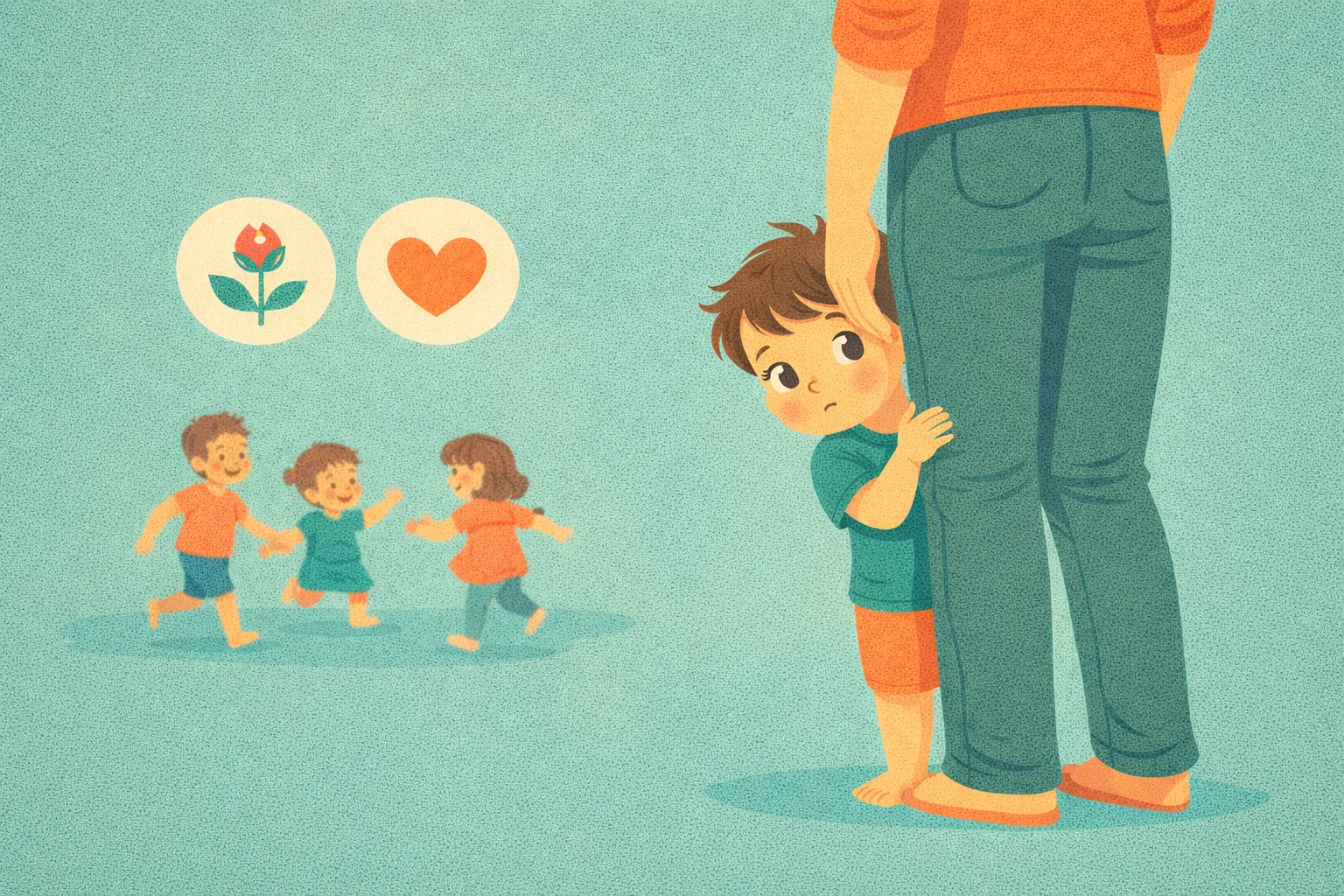
Picture this: a big family gathering, everyone happy to see you. Aunts, uncles, cousins — loud voices, hugs, expectations. Your shy child presses tightly against your leg and wishes they could just disappear. And then comes that comment — loud, well-meaning, but landing like a label: "They're so shy!"
You watch your child shrink. Maybe you feel a flicker of embarrassment — for your child, for the situation, for what others might think. And at the same time, you know deep down: your shy child isn't doing anything wrong. They're just... like this.
So what's really going on with shyness? What do shy kids actually need — and what hurts more than it helps? Let's take a closer look together.
- ✓Shyness is a temperament trait, not a flaw and nothing that needs to be "fixed"
- ✓The word "shy" as a label can stick — better to use neutral descriptions instead
- ✓Shy children need time to observe before joining in — that's real social work
- ✓Pushing increases anxiety; preparation and patience build genuine confidence
- ✓Social anxiety and shyness are not the same thing — the distinction matters
- ✓The strengths of shy children are real: empathy, observation, loyalty
What Is Shyness? Understanding Your Shy Child's Temperament
Shyness is not a character flaw. It's also not a phase that children simply "grow out of" if you apply enough pressure. Shyness is a temperament trait — part of how a child's nervous system responds to new situations and unfamiliar people.
Developmental psychologists call this the "slow-to-warm-up" temperament: children who need to observe before they participate. Who need time. Who want to feel safe before they show themselves. This exists on a spectrum — from mildly reserved to a temperament that closely resembles introversion.
Shyness doesn't mean a child doesn't want social connection. Shy children often long deeply for connection — just in their own way and at their own pace. Watching from the sidelines isn't passivity. It's social processing. Your child is learning while they watch.
If you'd like to learn more about how personality types develop in children, check out our guide to understanding your child's personality.
Shyness vs. Social Anxiety: An Important Distinction
Here's something many parents don't know: shyness and social anxiety are not the same thing — and the difference is crucial for figuring out how best to help your child.
Shyness is a temperament trait. It shows up most in new situations or around unfamiliar people. Once your child knows the situation and feels comfortable, they relax. They can have fun, laugh, join in — sometimes even loudly and freely. The hurdle is getting started, not being there.
Social anxiety goes beyond temperament. It persists even when the situation or the people have long become familiar. A child with social anxiety fears being evaluated, judged, or rejected — even in situations they actually know well. Typical signs include:
- Physical symptoms: stomachaches, nausea, trembling before social situations
- Actively avoiding situations, even when the child genuinely wants to participate
- Ongoing distress over many months that disrupts daily life
- Catastrophic thinking: "Everyone will laugh at me"
Ordinary shyness needs patience and the right environment. Social anxiety sometimes needs targeted therapeutic support. You can find more in our guide to anxiety in children.
What Shy Children Actually Need
Here's the most important thing to know: shy children do not need to be "fixed."
They don't need therapy because they don't say hello right away. They don't need punishment for hiding behind your back. They don't need endless conversations about why they should just try to be braver.
What they do need:
1. Time to observe Watching isn't avoidance. It's how your child processes social situations. When you say "Take your time, no rush," you're giving your child exactly what they need: safety.
2. Not to be labeled as shy This might sound surprising. But when adults say "She's shy" in front of the child, the child learns: that's who I am. The label becomes an identity. And then the child confirms the expectation — not because they have no choice, but because children live up to the images adults draw of them.
3. Having their rhythm respected Some children need five minutes to warm up. Others need the whole afternoon. That's okay. As long as you're present and not projecting expectations, your child will find their moment.
How Can You Help a Shy Child Without Pushing?
Now for the concrete strategies — things you can start doing differently as soon as tomorrow.
Don't narrate your child's behavior while they're standing right there
It happens automatically: someone asks your child something, they stay quiet, you step in: "She's a bit shy, she always takes a while." Well-meaning — but your child is listening carefully and learning: this is how I'm seen. This is who I am.
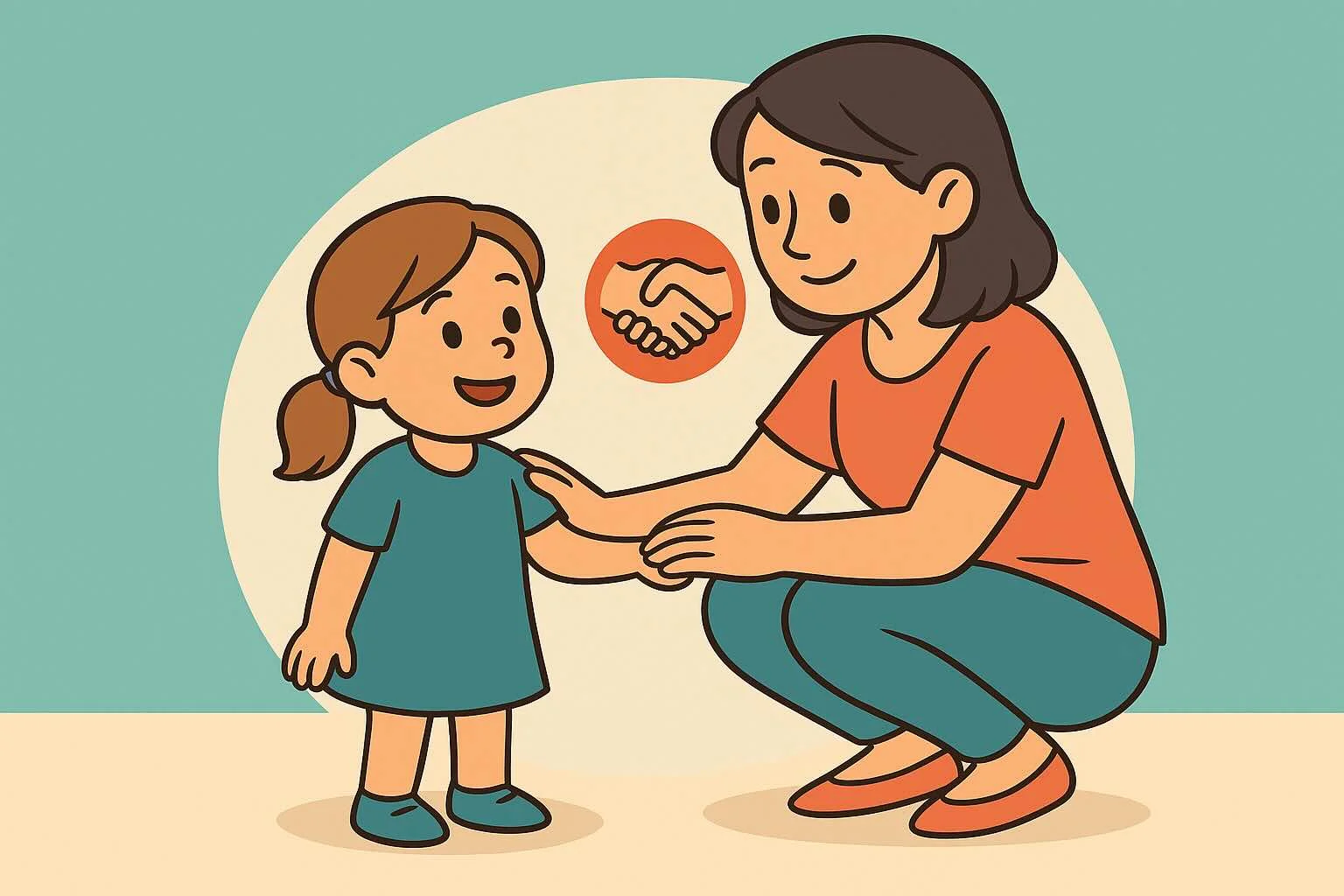
Allow a brief pause. Give your child a chance to answer on their own. If they still haven't said anything after a moment, you can quietly whisper: "Should I answer first? Or do you want to?" That hands them control without pushing.
Prepare your child for new situations
Shy children do much better when they know what to expect. Not as a warning, but as information:
- "Today we're going to Anna's birthday party. There will be around ten kids — some I know, some I don't. There'll be cake and games in the backyard."
- "You don't know Grandma and Grandpa very well yet. They're excited to see you — but they know you like to watch first. Everyone's fine with that."
Social situations feel less overwhelming for your child when they're predictable. That's not overprotecting — that's good preparation.
Practice social situations at home
Play through scenarios. "Imagine you're at a party and you don't know anyone. What could you say?" It might sound a little silly, but it makes a huge difference: your child rehearses social patterns in a safe environment before they need them in real life.
Short phrases you can practice together:
- "Can I play too?"
- "What are you playing?"
- "My name's Leo. What's yours?"
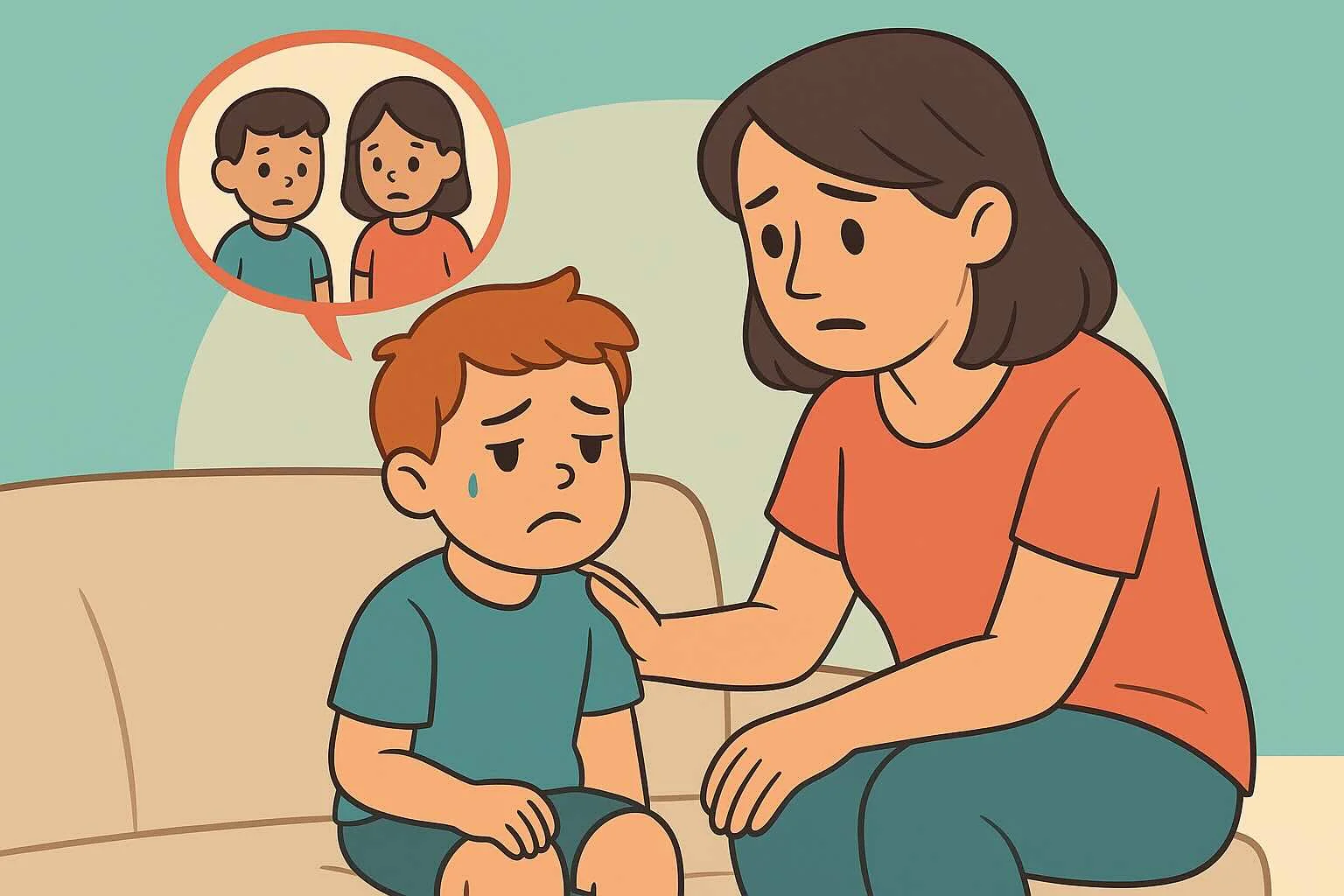
Why won't you say anything? Stop being so shy!
We can pause here and watch from outside for a bit. Then you can go in when you're ready.
Validate without over-reassuring
There's a subtle difference between helpful validation and unintentionally reinforcing anxiety.
Helpful validation sounds like: "I can see this feels hard right now. That's okay."
Over-reassurance sounds like: "Oh no, it's really not bad, you don't need to be scared, everyone's so nice, you'll see..." — this accidentally signals to your child that something actually is dangerous, because why else would Mom or Dad need to explain so much?
Less is more. Presence is stronger than words.
Our resources on social challenges offer additional strategies for common difficult moments.
Activities that are one-on-one rather than team-based — like Brazilian Jiu-Jitsu — can be especially effective for shy children because they remove the social pressure of group dynamics while still building confidence and connection at the child's own pace.
What Makes It Harder
Sometimes we mean well — and still make things harder. Here are the most common mistakes:
Repeating the label "She's shy" — in front of the child, around strangers, around relatives. Shy children absorb these statements and build their identity around them. Better: "She just needs a little time."
Forcing participation "Just say hello! What will people think?" Pressure creates more anxiety — not less shyness. A child who is forced to participate doesn't learn confidence. They learn to mistrust their own inner voice.
Comparing them to more outgoing siblings "Your sister just does it!" — that's not a motivator. It's a message that your child isn't okay as they are.
Overprotecting The opposite of pushing isn't sheltering completely. If your child never gets the chance to navigate gentle social challenges, they won't build the skills to handle them. The middle path: offer support, but don't remove the challenge.
For children whose shyness is tied to fear of new things, you'll find targeted strategies in our guide to fear of new experiences.
What Do You Say When Adults Label Your Child 'Shy'?
This is the situation that stresses out many parents the most: you're in a conversation, someone addresses your child, your child hides — and the other person announces loudly: "Oh, they're shy!"
Here are phrases you can use calmly:
- "He always takes a little while to warm up — once he does, he's the loudest one here." (with a smile)
- "She likes to watch first before joining in — that's just her style."
- "He'll say hello when he feels ready."
You don't need to get defensive. You don't need to explain or apologize. A calm, neutral response sends a clear message: I stand by my child. And I don't need to change my child to please anyone else.
If it's close family members who repeat the pattern regularly, a more direct conversation is perfectly fine: "It's important to me that we don't keep calling Jana shy. It sticks. Could you just say she needs a little time instead?"
The Strengths of Shy Children
Let's shift the frame — because shy children bring genuine strengths that are easily overlooked in a loud world.
Deep observation Shy children read social situations with remarkable precision. They notice when someone is sad. They listen when everyone else is already distracted. That's a form of social intelligence.
Genuine empathy Because shy children know firsthand what it feels like to be uncertain, they often have a finely tuned sense for when others are uncomfortable. They're rarely cruel or dismissive.
Deep friendships Shy children don't collect lots of surface-level connections — they invest in a few truly meaningful friendships. That loyalty is a gift.
Thoughtfulness Before shy children act, they think. That means they're less likely to make impulsive bad decisions, and more likely to approach things with care.
The goal isn't to turn your shy child into a more extroverted one. The goal is to help them know and appreciate who they are — while also developing the tools to act confidently even in challenging situations.
For a deeper look at the inner emotional lives of sensitive children, you'll find that shyness and sensitivity are often closely intertwined.
How to Help a Shy Child Make Friends
One of the questions parents of shy children ask most often is: will my child be able to make friends? The honest answer is yes, absolutely — but shy children often need a different path to friendship than their outgoing peers.
Start with one-on-one playdates Group settings are the hardest for shy children. A single playdate with one child in a familiar environment (your home) removes the social overload. One friend at a time is genuinely enough.
Help your child identify who they like Ask: "Is there anyone in class who seems nice?" or "Who do you like sitting next to?" This helps your child notice their own preferences — and gives you a name to invite over.
Give them opening lines to practice Shy children often freeze not because they don't want to connect, but because they don't know what to say first. Practice at home:
- "Do you want to play with me?"
- "Can I sit here?"
- "What are you reading?"
Stay nearby at first — then step back At playdates, be present in the background so your child knows you're there. Once they're settled, gradually create more space. They don't need your involvement — they need your proximity as a safety net.
Don't force it The single most counterproductive thing you can do is push: "Go introduce yourself! Just say hi!" Pressure shuts shy children down. Patience opens them up.
The good news: shy children may make fewer friends, but the friendships they build tend to be deep and lasting. Quality over quantity is a perfectly valid social style — and one worth celebrating.
Frequently Asked Questions
Here are answers to the questions parents of shy children ask most often.
Is shyness a personality trait or a problem?
Shyness is a temperament trait — not a flaw and not a weakness. Many children simply need more time to warm up, and that's just as normal as spontaneous kids who dive right in. Shyness only becomes a problem when it consistently and significantly limits a child and triggers real anxiety.
How can I help my shy child without pushing them?
Let your child observe before joining in. Prepare them for new situations by explaining what will happen. Practice social situations playfully at home. And above all: don't talk about your child in their presence as if they aren't there. Validate their feelings — "It's okay to watch for a bit first" — without reinforcing the shyness.
When is shyness a sign of social anxiety?
Normal shyness eases once a child knows the situation or the people involved. Social anxiety persists even when everything is familiar, triggers physical symptoms (stomachaches, trembling), leads to complete avoidance of social situations, and disrupts daily life for months at a time. If you notice these signs, it's worth having a conversation with your pediatrician or a child psychologist.
What do I say when other adults call my child "shy"?
Stay calm and friendly: "She just needs a little time to warm up" or "He likes to observe first before jumping in — that's just his style." This protects your child without putting you on the defensive. Feel free to ask relatives and friends directly to avoid using the "shy" label.
Can shyness be "overcome"?
The goal isn't to turn a shy child into a more extroverted one — that would work against who they are. Instead, it's about helping your child learn to thrive with their temperament and still do what they want to do. Many shy children grow into very fulfilled adults who experience their thoughtfulness as a strength.
Is shyness hereditary?
Yes, temperament has a strong genetic component. Research shows that around 20 percent of all children are born with a "slow-to-warm-up" temperament. That doesn't mean behavior is fixed, though — environment, experiences, and supportive parenting shape how that temperament unfolds.
How do I tell whether my child is introverted or socially anxious?
Introverted children enjoy social contact but need quiet time afterward to recharge. They warm up slowly, but then feel genuinely comfortable. Social anxiety goes beyond a quiet temperament: the child suffers, actively avoids social situations out of fear of judgment, and shows physical stress symptoms. Being introverted is a style — social anxiety is a source of distress.
How do I help my shy child make friends?
Shy children do best with one-on-one playdates in familiar settings rather than large group situations. Help your child identify one child they like at school, then invite that child over for a low-key playdate at home. Practice opening lines together ("Do you want to play?", "Can I sit here?") so your child has something ready. Stay nearby at first, then step back gradually once they're comfortable. Avoid pushing or rushing — patience opens shy children up far more than pressure does.
Your shy child doesn't need fixing. They need you — someone who knows them, sees them, and isn't trying to turn them into someone else.
That's the most powerful message you can give your child: you are exactly right, just as you are. I'm here. You know when you're ready.
Frequently Asked Questions
Download RootWise Today


Need personalized support?
RootWise's AI coach can provide tailored strategies for your specific situation, available 24/7 when you need it most.
Learn More About AI Coaching →