Why Boredom Builds Better Brains (And How to Let Your Child Be Bored)

Your 4-year-old says she's bored. You feel the familiar pull to fix it - suggest a craft, propose a snack, hand over the tablet, schedule a playdate. Resist.
Your child's complaint is not a problem to solve. It is the developmental gate her brain has to cross to start generating its own ideas. And what's on the other side of that gate is some of the most important brain-building of early childhood.
This guide is the case for boredom, the science behind it, what to actually say when they complain, and how to set up your home and your week so the boredom path leads somewhere real.
- ✓The AAP reaffirmed unstructured play as developmentally essential in 2026 - it builds executive function in ways scheduled activities cannot
- ✓45% of kids 8-12 in a 2026 Harris Poll said they prefer play adults don't organize
- ✓"I'm bored" is a 15-20 minute threshold, not a problem to fix
- ✓A "yes space" at home (child-safe, well-stocked with open-ended materials) is the single highest-leverage setup move
- ✓60+ minutes of outdoor active play per day is the baseline, not the goal
- ✓Two structured activities per week is plenty for most 2-8 year olds
What boredom is actually doing in your child's brain
The popular framing of boredom is negative - a void to be filled, a complaint to address, a deficit to remedy. The developmental framing is the opposite.
Boredom is what happens when external input has dropped below the level your brain expects. The brain interprets that drop as a problem to solve and starts generating internal input - thoughts, ideas, images, plans. This is the engine of imagination. For a developing brain, repeatedly crossing the boredom threshold and generating self-directed play is one of the main ways executive function gets built.
The American Academy of Pediatrics put it in plain language in its 2018 clinical report on play, reaffirmed and updated in 2026: play strengthens brain structure and function, particularly executive skills such as impulse control, emotional regulation, planning, and goal-setting. The report is specific that this is about unstructured play - the kind that emerges when a child has time, space, and no one telling them what to do.
A 2026 Harris Poll of more than 500 kids aged 8-12 found 45% would actively prefer play that adults don't organize for them. The kids know. They just don't get the chance often enough.
Why we got afraid of boredom
Three things conspired to make American parents allergic to child boredom over the last 25 years.
First, the rise of "intensive parenting" framed every unstructured moment as wasted - a moment that could have been spent on enrichment, learning, optimization. The implicit math: if my kid is bored, I'm failing.
Second, the smartphone arrived. Suddenly there was an instant boredom-killer in every parent's pocket. The path of least resistance became universal.
Third, the over-scheduling arms race took off. By 2010, the average middle-class American child had more weekly structured activities than at any prior point in measured history. Boredom became something parents felt they had paid to prevent.
The 2026 trend is a course correction on all three. Less intensive parenting, less default screen access, fewer over-scheduled activities. Multiple parenting media outlets are now reporting a measurable drop in enrollment for "competitive" activities for under-10s, and pediatric guidance is increasingly explicit that unstructured time is not a gap to fill but a developmental investment in its own right.
What "I'm bored" actually means at each age
Age 2
A 2-year-old who seems bored is usually under-stimulated in their body, not their imagination. The intervention is rarely "give them an activity" - it's "move them to a different environment." Outside is almost always the answer. The yes-space at home is the second answer.
Age 3
The 3-year-old has more language but limited internal life. Their "I'm bored" often means "I want you to play with me." Sometimes the right response is to play. More often, the right response is the warm-but-firm version of "I'm not the entertainment" - and the yes-space does the work.
Ages 4-5
This is the golden window for self-directed play. A 4-5 year old in a well-stocked yes-space with no screen access will often play for 60-90 minutes alone. The "I'm bored" complaint at this age is usually a habit that's been trained by parents who fix it too quickly. Stop fixing it. Watch what happens.
Ages 6-8
The 6-8 year old has full language, real preferences, and the early outline of an attention span. "I'm bored" at this age can mean "I want to do something specific but I'm not telling you" or "I'm tired but I don't recognize it" or just "I'm in the gap between two activities." The intervention is usually patience plus options - not entertainment. "There are 200 things in this house you could do. Pick one or don't. I'm not picking for you."
The 20-minute rule (and what to say at minute 4)
If you only take one thing from this guide, take this: most kids cross the boredom threshold in 15-20 minutes if you don't intervene.
The complaint phase is the gate, not the destination. Parents fail by intervening at minute 4, when the complaints are loudest and the parent's discomfort is peaking.
That's it. That's the line. Repeat as needed. Don't suggest activities. Don't list options. Don't apologize. Don't hand over a screen. Don't promise something later.
Sit with the discomfort. Yours and theirs.
Around minute 15-20, you'll see one of three things:
- They start playing - with toys, with a sibling, with a stick, with their own narration.
- They wander outside and start playing there.
- They sit quietly for a while doing nothing. (This is also fine. This is also growth.)
Setting up a "yes space" at home
The single highest-leverage setup move for boredom-tolerant kids is a yes-space. A section of your home where your child can play independently without you having to say "no" every 30 seconds.
The four criteria:
- Child-safe. Nothing breakable, nothing dangerous, no small items that go in mouths if you have a toddler. You should be able to leave the room for 5 minutes without worrying.
- Well-stocked with open-ended materials. Blocks, magnetic tiles, art supplies, books, dress-up clothes, kitchen toys, a few dolls or figures, things that can be put together and taken apart. NOT a pile of single-purpose battery-operated toys.
- Visible. You can see or hear them from where you spend time. Independence does not mean isolation - your presence in the next room is part of the safety they need to play.
- Rotating. Every 2-3 weeks, swap half the materials out for storage and swap stored materials in. Novelty without consumption.
For a 2-year-old, a yes-space might be a baby-gated corner of the living room. For a 5-year-old, it might be a bedroom with a low shelf of materials. For a 7-year-old, it might just be "the basement is yours after 4pm".
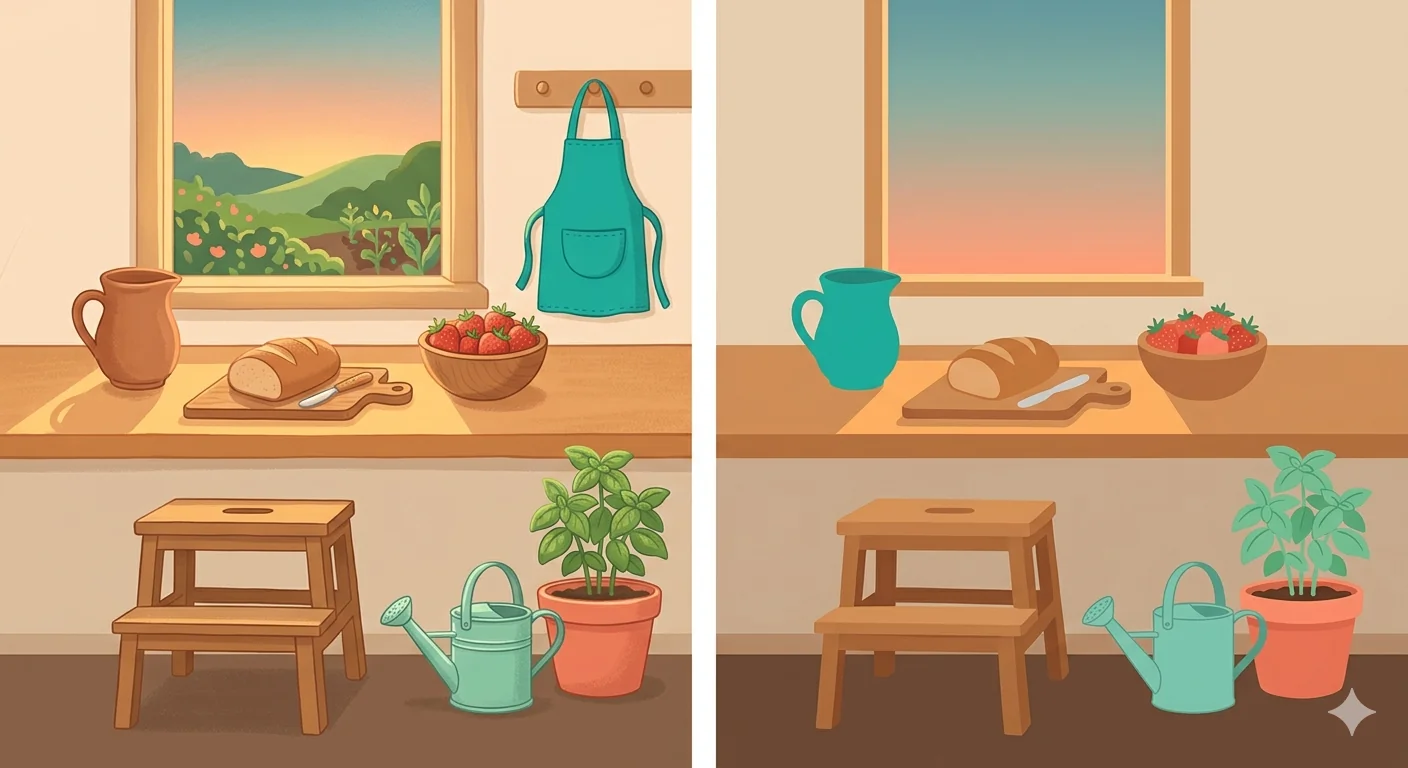
An open kitchen with knives, glass, and hot surfaces, where the parent says 'don't touch' 30 times an hour.
A child-safe living-room corner with blocks, books, art supplies, and dolls, where the parent says 'have fun' once and reads in the next room.
The yes-space isn't a luxury or a Pinterest project. It's a piece of infrastructure that makes independent play possible.
Outdoor unstructured play (the bigger lever)
For all the talk about indoor independent play, outside is the bigger lever. Outdoor play does in 30 minutes what indoor play does in 90 - more sensory input, more physical movement, more open-ended environment, more opportunity for problem-solving.
Pediatric guidance recommends at least 60 minutes of outdoor active play per day for children under 6. Most American kids fall well short of that. The 2026 reframe: outside is the default, not a treat.
What this looks like:
- Age 2-3: 30-60 minutes outside in a fenced yard, a courtyard, or at a park - while you sit nearby. They can wander. They can dig. They can stand and stare. All of it is play.
- Age 4-5: 60-90 minutes outside per day, ideally with another kid or two. You can be near but not directing.
- Age 6-8: 90+ minutes outside per day when possible. Backyard, neighborhood, friend's yard, woods, walk to a park alone or with a sibling.
Cold, light rain, and modest heat all count. Children dressed for the weather get the same developmental benefit. The Norwegian saying applies: there is no bad weather, only bad clothes.
The free-range question (is it okay to let them play unsupervised?)
The stigma against letting young children play unsupervised has eroded substantially in 2026. Several US states have passed "reasonable childhood independence" laws (Utah, Oklahoma, Colorado, Texas, Illinois, and others) clarifying that age-appropriate independent activities are not neglect. The conversation has shifted from "is it safe?" to "what's the cost of over-supervision?"
The research-supported answer: over-supervision has real costs - higher child anxiety, weaker problem-solving, less developed resilience. The "safe enough" bar isn't zero risk. It's calibrated to age and environment.
A reasonable progression by age:
- 2-3: in your sight or in a securely fenced area while you're nearby.
- 4-5: in the backyard alone, in a courtyard with other kids while you're inside, at a playground while you sit on a bench reading.
- 6-7: walking to a neighbor's house, biking on a quiet street with siblings, playing in a park while you stay at the edge.
- 8: walking to school with a friend, running a small errand, spending an afternoon at a friend's house without you present.
This is not a checklist. Every neighborhood, every child, and every family is different. But the trend across 2026 has been toward expanding the range, not contracting it.
The over-scheduling question
A widely-quoted 2026 X post captured the energy: "Limiting my kids' exposure to screens is the best thing that has happened to me this year. Now they are well-adjusted kids with little to no tantrums, replaced with colouring books, puzzles, pretend play."
Parents are noticing the same pattern when they cut activities. Less structured time, more free play, fewer tantrums.
The reasonable upper bound for most 2-8 year olds: two structured activities per week. One physical (swimming, soccer, gymnastics), one creative or social (music, art, faith community). That's it.
The rest of the after-school hours are for:
- Outdoor unstructured play (the biggest single block).
- Independent play in the yes-space.
- Family time - dinner together, reading together, cooking together.
- Rest and quiet.
If your child seems chronically overwhelmed and your week is full, the answer is almost never "add another activity." It's "drop one."
What to do this week
Three changes you can start tomorrow:
- One 30-minute "no plans, no screens" block. Same time of day, every day. Your child has to entertain themselves with whatever's in the house. You can be in the same room but you are not the entertainment. Survive the first three days. By day five you'll watch them invent a game.
- Move one indoor activity outdoors. Snack on the porch. Reading on the lawn. Drawing on the driveway with chalk. Just move it outside. The bar is low.
- Cut one structured activity. If you have three or more per week per child, drop the lowest-priority one. You will not damage your child. You will give them back time.
What to read next
- Screen time alternatives and activities - specific things to fill the unstructured time
- Phone-free childhood - the screen side of the same trend
- Teaching independence and life skills - what to do with the freed-up time
- Building cooperation without rewards - the parenting voice that fits this approach
- 2026 parenting trends round-up - the full picture
The one-line summary
Boredom isn't a problem - it's the gate to self-generated play. Set up a yes-space, default to outside, hold the line for 15-20 minutes when they complain, and cut one activity from the week. The developmental work happens in the time you don't fill.
Frequently Asked Questions
Download RootWise Today


Need personalized support?
RootWise's AI coach can provide tailored strategies for your specific situation, available 24/7 when you need it most.
Learn More About AI Coaching →