6 Year Old Not Listening? 7 Expert Strategies for First Grade Cooperation

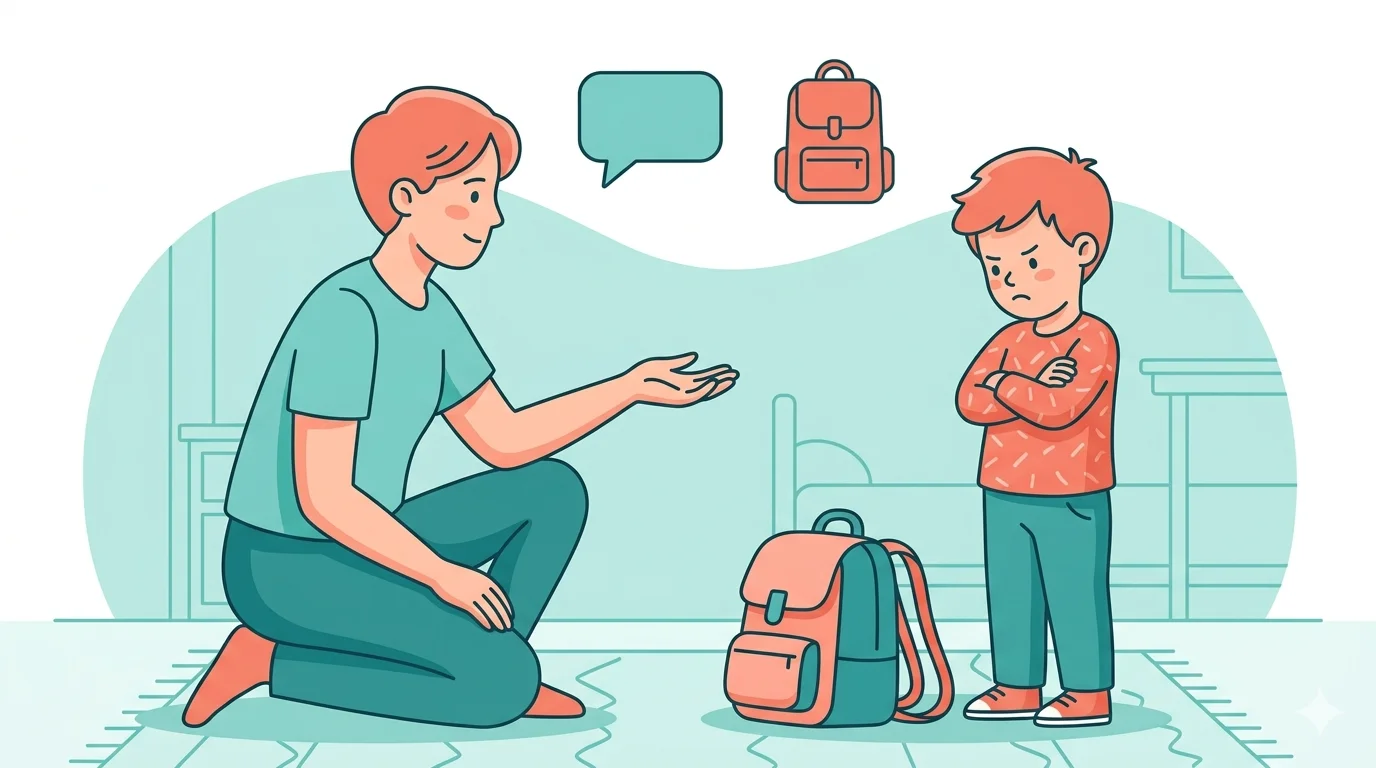
Your 6-year-old spent seven hours today following instructions without complaint. They raised their hand, walked in a line, sat in their seat, and cooperated with twenty different requests from their teacher. Their teacher probably thinks they're delightful.
Then they came home, you asked them to put their shoes away, and everything fell apart.
This gap — perfectly compliant at school, seemingly unable to follow a single direction at home — is one of the most common and bewildering patterns parents of first graders encounter. If you've spent evenings locked in repetition cycles, wondering what happened to the cooperative child who apparently exists at school, you're in exactly the right place.
Here's the key insight: the problem isn't that your 6-year-old doesn't listen. It's that they've used up everything they had listening all day — and you're getting the honest, exhausted version they can't show anyone else.
- ✓After-school meltdowns are self-regulation tank exhaustion, not disrespect — first graders burn every compliance reserve at school
- ✓A 15-20 minute decompression window before any requests dramatically shifts the evening trajectory
- ✓Lead with the reason, then the request — 6-year-olds need the "why" before their brain will engage with the "what"
- ✓Offer structured choices (not "do/don't do" but "which of two ways") to satisfy autonomy needs
- ✓Falling apart at home while holding it together at school is a sign of trust — they feel safe enough to show their worst self with you
The 6-Year-Old Brain: Why Home Is Where Rules Go to Die
The Self-Regulation Tank
Think of self-regulation — the ability to manage behavior, emotions, and impulses — as a tank that fills overnight and drains throughout the day. At school, your child drains that tank with every transition, every instruction, every moment of sitting still, every peer conflict managed diplomatically.
By 3:30pm, many first graders are running on fumes.
This is not laziness or disrespect. It's neurobiology. Dr. Stuart Shanker, author of Self-Reg, describes this as the "stress response load" — the cumulative energy cost of regulating behavior in demanding environments. School is cognitively and emotionally demanding in ways that are invisible to us as adults. For a 6-year-old, holding it together all day is genuine work.
When they arrive home and you ask them to take off their backpack, you're making one more demand of a system that has almost nothing left to give.
What's Developmentally New at Age 6
Several shifts make this age particularly challenging — and particularly important to get right:
Logical reasoning is accelerating. Your 6-year-old is no longer satisfied with rules handed down from authority. They want reasons, and they're beginning to evaluate those reasons. "Because I said so" worked at 3. At 6, it's an invitation to argue. This is not obstinacy — it's a developing mind doing exactly what it should.
Justice sensitivity is awakening. Six is the age when children begin comparing their experience to others' with intensity. "Jayden doesn't have to clean his room every day." "You let Mia stay up later than me." These comparisons feel deeply unfair and are meant literally. Your child isn't being manipulative — they're processing a newly complex social world where fairness feels like oxygen.
Home is the safe decompression zone. The fact that your child holds it together at school and falls apart at home is, in a strange way, a sign that your relationship is healthy. They feel safe enough with you to be their worst self. The child who can't regulate at home but performs perfectly at school is showing you where their deepest trust lies — even if it doesn't feel like trust in the moment.
First grade demands are significant. Reading, writing, arithmetic, sitting in a seat, managing peer relationships, navigating a new social hierarchy — first grade is academically and socially intense. Many children experience a developmental squeeze between their expanding awareness of expectations and their still-limited capacity to meet them consistently.
Understanding these power dynamics is the first step toward changing the dynamic at home.
7 Strategies for When Your 6 Year Old Isn't Listening
1. Honor the Decompression Window
Before you ask anything of your child after school, give them 15-20 minutes of genuine nothing. A snack, unstructured play, outdoor time, or even silent screen time if that's what they need. No questions about school, no instructions, no agenda.
How to do it:
Create a simple after-school ritual: snack ready on the table, shoes off, a brief hug, then freedom. Hold all requests and conversations for after the window.
Script for the conversation: Parent: "I know you're tired from school. Snack's on the table — take some time to chill. We'll connect in a bit."
After the window: Parent: "Okay, you ready? I need help with two things before dinner. Which do you want to do first — set the table or let the dog out?"
Why it works: Research on decision fatigue shows that cognitive performance and self-control decline with sustained mental effort. The 20-minute buffer allows your child's nervous system to downregulate, replenishing the self-regulatory resources they need to cooperate. You're not avoiding requests — you're timing them strategically.
Parent story — Carmen's experience: "We used to have terrible after-school meltdowns every single day. My daughter Eva would walk in the door and within ten minutes we'd be in a full screaming argument about her backpack. I started setting out a snack and just not talking for the first twenty minutes. The difference was instant. She decompress, eats something, and now she's actually pleasant to be around. I wish someone had told me this in kindergarten."
2. Give the Reason First
At 6, your child's brain is asking "why?" about every instruction, even if they don't say it out loud. When you lead with the reason, you remove the automatic pushback.
How to do it:
Flip the order of your instructions. Instead of issuing the directive and then explaining (if at all), explain first and then ask.
Instead of: "Put your toys away." Try: "We have dinner in ten minutes and I need the floor clear so we can all move around safely. Can you put your toys away?"
Instead of: "Turn off the iPad." Try: "Your brain needs a break from screens before bed so it can actually wind down. In five minutes, iPad goes off — want to choose what you do after?"
Because I said so. End of discussion.
Here's why: [reason]. So I need you to [action]. Do you want to do it now or in five minutes?
Script for the conversation: Parent: "Hey, I want to explain something before I ask you to do it. We're going to Grandma's tomorrow, which means the house needs to be tidy tonight or I'll be stressed all evening. That makes me cranky. Can you help me with your bedroom?"
Why it works: When children understand the reason behind a request, they're engaging their prefrontal cortex — the thinking brain — instead of their reactive brain. Dr. Daniel Siegel's research on "name it to tame it" extends here: when we make the logic explicit, children can engage with it rather than react against it. Compliance becomes a choice, not a demand.
Parent story — Marcus's experience: "My son Leo argued with everything. I started giving reasons before requests and it genuinely changed our dynamic. Instead of 'clean your room,' I'd say 'I get overwhelmed when there's clutter everywhere — it actually stresses me out. Can you help me out?' He started taking it seriously. He didn't know I actually felt that way. Now he often does things without being asked if he can see I'm stressed."
3. Offer Structured Choices
Six-year-olds are in a developmental push for autonomy. Every instruction that leaves no room for input triggers a subtle counter-will response — the instinct to resist simply because they had no choice in the matter. Structured choices thread the needle: you get what you need, they get to feel in control.
How to do it:
Build two acceptable options into every request where possible. The choice is never between doing and not doing — it's always between two paths to the same outcome.
Examples:
- "Teeth need to be brushed — do you want to do it now or in five minutes?"
- "We're going to clean up before the movie — do you want to start with LEGOs or the books?"
- "Homework has to happen today — do you want to do it before or after your snack?"
Why it works: Autonomy is a fundamental psychological need. Research by Edward Deci and Richard Ryan on Self-Determination Theory shows that humans of all ages are dramatically more cooperative when they feel they have genuine choice in an outcome. By offering a structured choice, you preserve your child's need for autonomy while maintaining the non-negotiable requirement.
Parent story — Jana's experience: "I was giving my daughter Clara so many direct commands that it felt like I was barking orders all day. I switched to choices and she went from about 30% compliance to nearly 100%. She almost never fights me on things now if I frame it as 'which way would you like to do this?' The funny thing is I always get what I need — the choice is always between two options I'm happy with."
4. Write It Down Instead of Saying It
By first grade, your child can read. Use that. Moving instructions off your voice and onto something visual removes the dynamic where your voice triggers automatic resistance.
How to do it:
Create a simple after-school checklist together. Let your child help decorate it. Post it somewhere they pass every day.
Sample After-School Checklist:
- Shoes and backpack put away
- Snack
- Free time (20 min)
- Check homework folder
- Outside time or play
Script for the conversation: Parent: "Instead of me reminding you about stuff every afternoon, let's make a list you can check yourself. That way I don't have to nag and you get to be the one in charge of it."
Child: "Can I draw pictures instead of words?"
Parent: "Yes, absolutely. Let's do it together."
Why it works: Visual checklists shift authority from you to the system — and at 6, fighting a checklist feels different from fighting your parent. This technique, widely used in occupational therapy and positive behavior support programs, externalizes the demand so it no longer feels personal. Many children also feel genuine pride in checking items off independently.
5. Solve Problems Together, Not Alone
When a recurring conflict keeps happening — homework battles, morning chaos, screen time fights — stop trying to fix it with commands and start solving it collaboratively. At 6, your child has enough cognitive capacity to be a genuine partner in problem-solving.
The Collaborative Problem-Solving approach (developed by Dr. Ross Greene):
- Empathize: "I've noticed we keep having a really hard time with [situation]. What's making it hard for you?"
- Share your concern: "Here's what I'm worried about — [your concern]."
- Invite solutions: "Can we figure out a plan that works for both of us?"
Script for the conversation: Parent: "I want to talk about homework. We've been having a lot of fights about it and I don't want that. What makes homework hard after school?"
Child: "I'm tired. And it's boring."
Parent: "That makes sense. I'm worried that if homework doesn't get done, you'll fall behind. What if we tried doing it later — like after your outdoor time — with a special snack? Would that help?"
Child: "And can I pick what snack?"
Parent: "Deal."
Why it works: Children who participate in creating solutions are dramatically more likely to follow them. This approach treats non-compliance as a problem to solve together rather than a battle to win. It's slower than commanding, but the cooperation it produces lasts.
Parent story — Deepa's experience: "My son Rohan fought me on bedtime every single night. Instead of escalating the consequences, I sat down with him and asked what was hard about bedtime. He told me he was scared of being alone in his room. I had no idea. We worked out a plan — audiobook playing quietly, nightlight, door open a crack. Bedtime went from forty-five-minute battles to ten-minute routines almost overnight. He just needed to be heard."
6. Use the When-Then Bridge
This strategy reframes requests as logical sequences rather than commands, which resonates with a 6-year-old's developing logical mind.
Instead of: "Do your homework before you play." Try: "When homework is done, then you can play outside."
Instead of: "Clean your room or you're not going to the park." Try: "When your room is tidy, we can head to the park."
The key difference from a threat: You're describing a sequence, not issuing an ultimatum. The tone is matter-of-fact and inevitable — like saying "when it rains, we use umbrellas." There's no anger in it, no negotiation implied, no power struggle invited.
Why it works: "When-then" frames the request in terms your child's logical brain can engage with. It acknowledges natural cause and effect without implying punishment. It's also inherently respectful — it tells your child what will happen rather than what you will do to them.
7. Follow Through with Empathy, Not Escalation
When your 6-year-old still doesn't listen after you've tried everything, the temptation to yell, threaten, or punish is real. But how you follow through shapes the relationship — and whether cooperation becomes the norm or the exception.
The Empathetic Follow-Through Formula:
- Acknowledge what they're feeling: "I know you really don't want to stop."
- Hold the line briefly: "And it's time."
- Follow through with action, not more words.
- Avoid lecturing, shaming, or predicting future behavior.
What this sounds like: "I can see you're in the middle of something important. That's really hard to stop. And dinner is ready — come on, let's go. You can finish after."
What to avoid:
- "I've told you ten times already!" (shame and escalation)
- "Why do you never listen?" (character attack)
- "That's it, no TV for a week." (disconnected, disproportionate)
- "You're so selfish." (shame)
For children whose non-compliance regularly involves intense emotional reactions, our guide on 6-year-old tantrums addresses the emotional regulation piece directly.
When Homework Triggers the 6 Year Old Listening Battle
Homework refusal is one of the most common forms of non-compliance at this age — and one of the most misread. Parents often interpret it as defiance; what's actually happening is executive function depletion.
Your 6-year-old has spent 6-7 hours at school using the same brain systems that homework requires: focus, sustained effort, following instructions, and managing frustration. By 3:30pm, those systems are running low.
Strategies specifically for homework battles:
- Shift the timing. Try homework after a 20-30 minute snack and outdoor decompression window. Homework at 5:00pm after decompression is often smoother than homework at 4:00pm while still in school mode.
- Sit nearby, not hovering. Your physical presence — reading, working on something of your own — reduces the isolation children feel with homework without creating dependency.
- Break it into chunks. "Do all your homework" is overwhelming. "Do three math problems, then take a break" is manageable. Use a timer: 10 minutes on, 5 minutes off.
- Make success visible. A simple chart where your child checks off homework for each day creates a sense of accomplishment and removes the daily verbal battle over whether it happened.
If resistance is intense and persistent, revisit Strategy 5 — Collaborative Problem-Solving — and apply it specifically to homework. Ask what makes homework hardest, share your concern about keeping up at school, and build a plan together.
When "Not Listening" May Signal Something Deeper
Red Flags That Warrant Professional Attention
Selective compliance is universal at 6. However, speak with your child's pediatrician if you observe:
Attention and focus concerns:
- Inability to complete any enjoyed activity for 10-15 minutes without redirection
- Consistent teacher reports of inattention or impulsivity at school
- Difficulty following two-step instructions even when calm and motivated
- Significant fidgeting or restlessness beyond typical 6-year-old energy levels
Processing and comprehension concerns:
- Frequently asks "what?" even in quiet, one-on-one conversations
- Struggles to remember routines completed daily for months
- Difficulty understanding age-appropriate instructions or conversations
- Significant delays compared to peers in reading or language
Emotional and behavioral concerns:
- Daily extreme meltdowns (30+ minutes) that don't calm with support
- Aggression toward people or property when given instructions
- Marked anxiety about normal expectations or transitions
- A sudden regression in behavior after previously established patterns
If your child's non-compliance seems connected to worry, our childhood anxiety guide explores how anxiety often presents as defiance in children.
Your 4-Week Action Plan
Week 1: Introduce the Decompression Window
- Establish a 20-minute after-school buffer — snack, no demands, no questions
- Practice giving reasons before instructions for every significant request
- Track: How many times do you repeat yourself per day? (Observe without judgment.)
Week 2: Install Written Systems
- Create one visual checklist together (after-school routine)
- Replace at least three daily verbal reminders with pointing to the chart
- Introduce "when-then" framing for your two most common friction points
- Track: How often does your child reference the checklist without prompting?
Week 3: Shift to Collaboration
- Identify your most recurring conflict and schedule a 10-minute problem-solving conversation (not in the moment — when everyone is calm)
- Practice the empathetic follow-through on at least one non-compliance per day
- Start offering structured choices for 3-4 daily decisions
- Track: Do you notice fewer power struggles on days when your child had more choices?
Week 4: Refine and Consolidate
- Note which strategies work best for your specific child
- Let go of any that don't feel natural for your family
- Share what's working with your child: "Our afternoons have been so much better. The checklist idea is really helping."
- Identify the next friction area to tackle together
What to Expect: A Realistic Timeline
Week 1: Expect testing. Your child will push to see if the new approach is real or temporary. You may feel like nothing is working. This is normal — they're assessing consistency, not defying you.
Weeks 2-3: You'll notice improvement in specific areas where new systems are in place. Other areas may still be rocky. Progress is uneven — a better afternoon can be followed by a rough morning.
Month 2: A clear pattern shift emerges. Power struggles decrease. You find yourself raising your voice less. Your child starts referencing the checklist or the agreements you made together.
Month 3 and beyond: Cooperation becomes the household baseline for most daily routines. Hard days still happen — they always will — but they're exceptions rather than the daily norm. Your 6-year-old begins to internalize the problem-solving approach, applying it to conflicts with siblings and peers.
Your Next Steps
Parenting a 6-year-old who doesn't listen can feel like fighting a current you can't see. The strategies above won't eliminate every conflict — nothing will — but they shift the dynamic from adversarial to collaborative in a way that compounds over time.
Start with what resonates most. If afternoons are your hardest stretch, begin with the decompression window. If homework battles dominate your evenings, schedule that collaborative problem-solving conversation. You don't need to implement everything at once — one meaningful change is enough to begin shifting the pattern.
For age-specific scripts and scenarios, our positive discipline examples for 6-year-olds provide word-for-word guidance you can adapt immediately.
If you're working through the not-listening years across ages, see what's different at 5 years old or 7 years old.
To understand why children tune out parents across all ages, our guide on why children ignore their parents covers the broader pattern and what drives it.
You're raising a thinker — a child who questions authority, wants explanations, and pushes for fairness. That child is going to need exactly those qualities as an adult. Your job right now is not to silence those instincts but to channel them. And that work, done consistently and with warmth, builds the kind of relationship that carries you both through the harder years ahead.
Frequently Asked Questions
Download RootWise Today


Need personalized support?
RootWise's AI coach can provide tailored strategies for your specific situation, available 24/7 when you need it most.
Learn More About AI Coaching →