Lighthouse Parenting: Steady Guidance for Confident, Resilient Kids


Mia is four. She's standing in front of the door with her left shoe on her right foot, the velcro flapping, her face going red. Her dad is two steps away with his coffee. He could fix the shoe in three seconds. They're already late.
He doesn't move.
"That looks tricky," he says. "What do you want to try?"
Mia stares at the shoe. She pulls it off, turns it around, jams her foot back in. The velcro catches. She looks up — not at the shoe, at him. He gives her a small nod. She runs to the car.
That tiny exchange is lighthouse parenting in motion. Not hovering. Not absent. Steady, visible, trusting — a light on the shore while she figures out the waves.
- ✓Lighthouse parenting was named by pediatrician Dr. Ken Ginsburg as a balanced middle path between helicopter and free-range styles
- ✓The parent stays a stable, visible presence — clear expectations and warm availability — while the child does the actual navigating
- ✓It's the felt version of authoritative parenting: high warmth, clear limits, real autonomy
- ✓For 2- to 7-year-olds, it looks like offering choices, naming feelings, pausing before rescuing, and letting small struggles run their course
- ✓It's not permissive — the light still has to stay on. Boundaries, follow-through, and presence are non-negotiable
What Lighthouse Parenting Actually Means
The term "lighthouse parenting" was coined by Dr. Kenneth Ginsburg, a pediatrician at Children's Hospital of Philadelphia and the founding director of the Center for Parent and Teen Communication. He introduced it in his 2015 book Raising Kids to Thrive and made it the centerpiece of his 2025 follow-up, Lighthouse Parenting: Raising Your Child With Loving Guidance for a Lifelong Bond.
His description is simple. A lighthouse parent is "a stable force on the shoreline" their child can measure themselves against. The job, in his words, is to look down at the rocks and make sure the child doesn't crash against them — but to look out at the waves and trust that the child will eventually learn to ride them. And to prepare them for that work.
The metaphor matters because it solves a real tension every parent feels: how to keep a small child safe without smothering the very capability you're trying to grow.
Unpacking the Lighthouse Metaphor
A lighthouse has four properties worth noticing.
It's stable. It doesn't move when the storm gets loud. A child in distress needs to know their parent isn't going to panic with them.
It's visible. The light is always on. The child knows where to look. They don't have to wonder whether you're there.
It's not in the boat. This is the hardest part. The lighthouse stays on the shore. It doesn't try to steer the boat or lift it out of the water. The child does the sailing.
It marks the rocks. The light isn't just decorative. It tells the child where the real danger is — the things that genuinely matter. Not every wave. Just the rocks.
{{info: Ginsburg's books — Raising Kids to Thrive (2015) and Lighthouse Parenting (2025) — root the concept in decades of adolescent medicine, but the underlying skills start in the toddler years. Every "do you want to try first?" you offer a four-year-old is the same skill you'll need when they're fourteen.}}
Lighthouse vs. Helicopter, Snowplow, and Free-Range
Lighthouse parenting is easiest to understand by what it isn't.
Helicopter parents hover. They intervene before the child has a chance to struggle, answer questions directed at the child, and manage every social and emotional ripple. The intent is protection; the effect is dependence.
Snowplow (or lawnmower) parents go further. They clear obstacles from the child's path before the child even sees them. The road is smooth — but the child never learns how to navigate one that isn't.
Free-range parents sit at the opposite end. They give children significant independence, often more than feels comfortable to other parents, and trust them to handle natural consequences. At its best, this builds resilience. At its worst, it leaves a young child without enough scaffolding to feel safe.
Lighthouse parents sit between these — much closer to free-range than helicopter, but with the light always on. Visible structure, real warmth, and genuine trust that the child can do the work.
Let me put your shoes on — we're already late.
Your shoes look tricky today. Want to try first, or want help?
What Lighthouse Parents Actually Do
This is the part most articles skip. Here's what the approach looks like in everyday moments with a 2- to 7-year-old.
-
Set clear expectations and explain them. "We hold hands in the parking lot — that's how we stay safe." Not "because I said so."
-
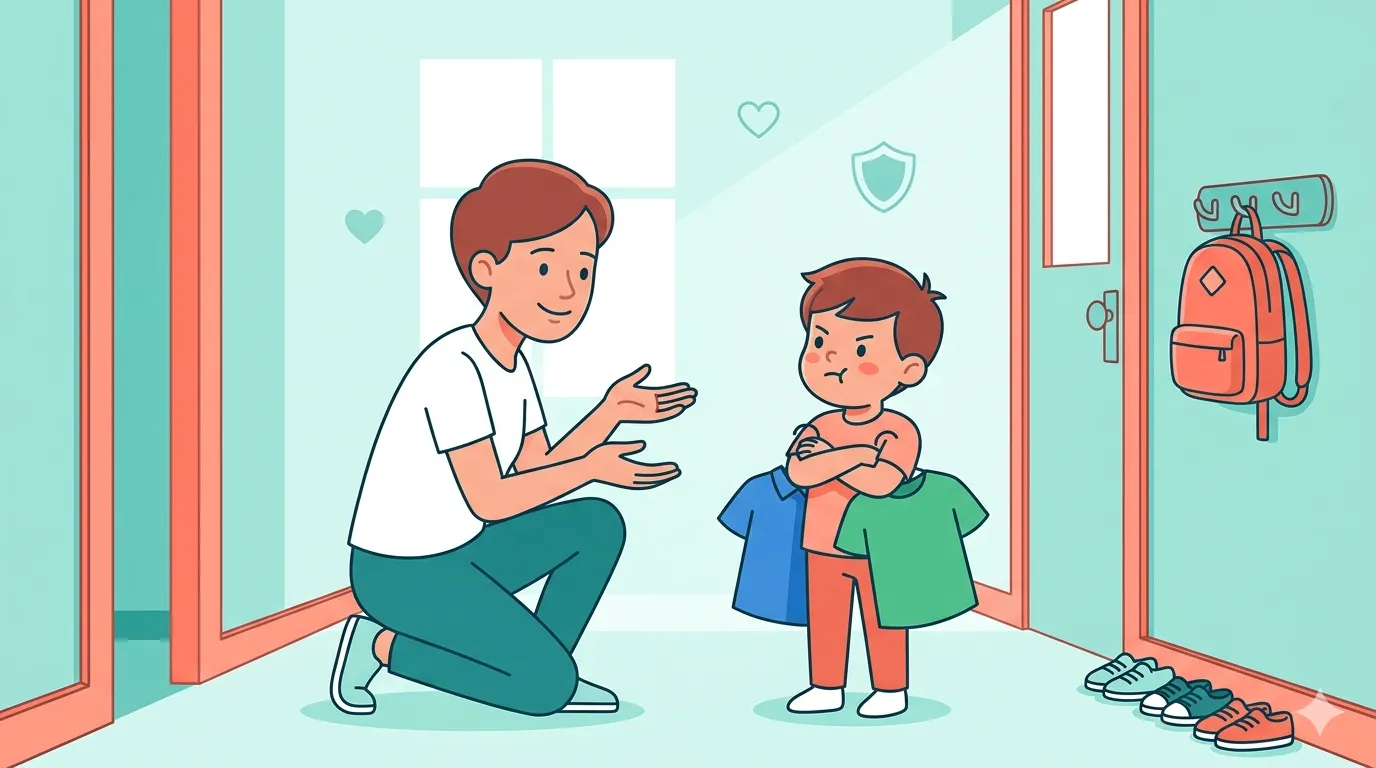
Offer real choices inside firm limits. "We're leaving in five minutes. Do you want to put on your shoes first, or your jacket first?"
-
Pause before stepping in. Count to ten. Most "I can't!" moments resolve themselves in those ten seconds.
-
Narrate what you see instead of directing. "You're working on getting that zipper started" instead of "Here, let me."
-
Name the feeling before fixing the problem. "That's frustrating — the tower keeps falling." Then wait.
-
Let the small failures land. Spilled water, mismatched socks, a tower that collapses. These are the reps where capability is built.
-
Stay close enough to be found. When your child looks over, you're there. You don't have to do anything — being seen is the whole job.
-
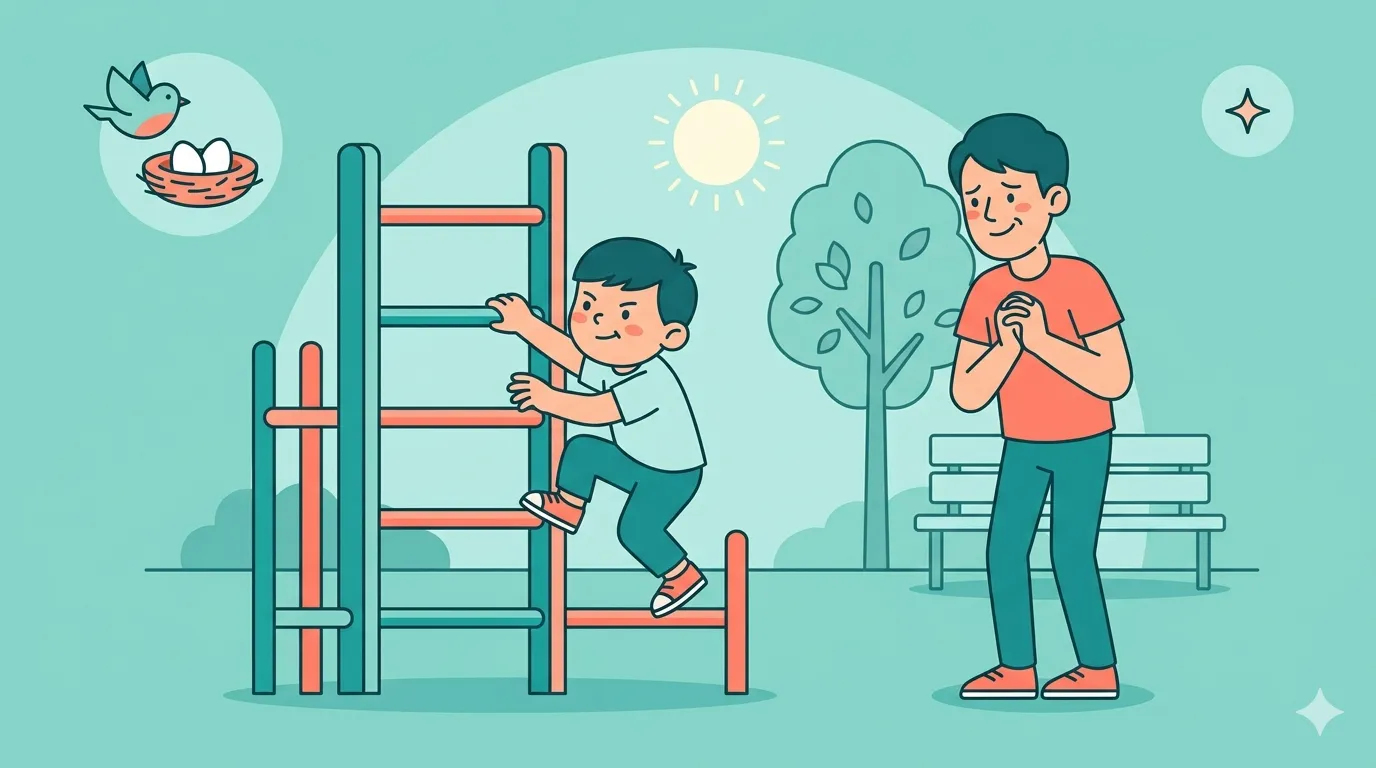
Repair when you overstep. "I jumped in too fast on the slide just now. I'm sorry — I know you can climb that yourself." Repair is part of the light.
-
Hold the boundary on the rocks. Some things — running into the street, hitting a sibling, an unsafe climb — are not negotiable. Lighthouse parents don't go soft on safety.
What It Looks Like at Each Age (2 to 7)
The light stays the same. The distance from the shore changes.
Ages 2-3: The Light Is Very Close
Toddlers need you nearby for almost everything. Lighthouse parenting at this age looks like:
- Two-option choices ("blue cup or green cup?")
- Naming feelings out loud ("you're sad the song ended")
- Letting the child try first when it's safe ("you turn the handle, I'm right here")
- Holding non-negotiables warmly ("I won't let you hit. I'll move your hand.")
Ages 4-5: The Light Stretches Out
Preschoolers can do far more than we usually let them. Try:
- Letting them dress themselves (mismatched is fine)
- Stepping back during minor playdate disputes for 60 seconds before mediating
- Asking "what do you think you could try?" instead of giving the answer
- Letting them carry their own backpack, even if it's slow
Ages 6-7: The Light Is on the Horizon
Early-school-age children need to start owning more of their world. Lighthouse parenting now means:
- Letting them work through mild homework frustration before jumping in
- Asking them to advocate for themselves with familiar adults ("you can ask the librarian")
- Letting small social bumps (a friend not sharing, a turn lost) play out
- Holding the line on safety, sleep, and respect — but loosening it everywhere else
When Lighthouse Tips Into Something Else
Lighthouse parenting only works if the lighthouse stays lit. It's easy to drift, and the drift usually goes one of two ways.
Toward helicopter. You step in too fast. You answer for the child. You finish the sentence, fix the puzzle, smooth the disagreement. The light stops being a light and starts being a tugboat.
Toward neglect dressed as freedom. You step back so far the child can't find you. You skip the boundary because it's exhausting. You tell yourself you're "fostering independence" when you're actually checked out. A lighthouse that no one tends is not lighthouse parenting — it's a dark coast.
The check is honest and quiet: Am I close enough to be found, and far enough to be useful?
How to Start Being a Lighthouse Parent Today
You do not need to overhaul your parenting. You need one small, repeatable shift.
Step 1: Pick one situation. Choose one moment that happens daily — getting dressed, leaving the playground, a small homework task — where you usually take over.
Step 2: Add a pause. Before you intervene, count to ten. Use the pause to notice your own urge before you act on it.
Step 3: Narrate, don't direct. "I see you working on that" is a complete sentence. It doesn't need a fix attached to it.
Step 4: Offer the choice. "Do you want to try first, or do you want help?" — and then honor the answer, including when they pick "help."
Step 5: Stay visible. When they look over, meet their eyes. That look is them checking the light. Just be there.
That's it. One moment a day. The shift compounds faster than you'd think.
I'm going to be a lighthouse parent now. I won't intervene anymore.
Today, in this one moment, I'm going to pause for ten seconds and let her try.
How Lighthouse Parenting Connects to Other Approaches
Lighthouse parenting isn't a separate ideology — it's a vivid name for what developmental research has been saying for fifty years. It overlaps almost entirely with authoritative parenting (Baumrind's high-warmth, high-structure style), and it's the natural correction to the helicopter pattern so many caring parents fall into. If you're trying to make sense of where your own approach sits, the broader parenting styles guide is a good companion read.
The reason the lighthouse metaphor has caught on — in pediatric clinics, in German parenting magazines under the name Leuchtturm-Eltern, in Spanish-speaking communities as padres faro — is that it gives parents something rare: a clear picture of what to be, not just a list of what to avoid.
What Your Child Gains
When you parent like a lighthouse, the gift to your child isn't a smoother ride. It's something more durable.
- They learn that struggle is survivable, because they've survived small ones with you watching
- They build confidence from evidence, not encouragement — they did it, and they know they did it
- They develop a working sense of which problems are theirs to solve and which need help
- They keep coming back to you, because the light stayed on
- They carry an internal version of you into the world: a steady voice that says "you've got this, and I'm right here"
That last one is the long game. Ginsburg's whole point — across both books — is that lighthouse parenting isn't really about childhood. It's about the relationship you'll still have with this person when they're twenty-five, thirty-five, fifty. Children who grew up with a steady light tend to come home to it for the rest of their lives.
Frequently Asked Questions
What is lighthouse parenting? Lighthouse parenting is a balanced approach named by pediatrician Dr. Ken Ginsburg, in which the parent stays a steady, visible, trustworthy presence on the shore while the child learns to navigate their own waves. Clear expectations, warm availability, real autonomy — and no climbing into the boat.
How is lighthouse parenting different from helicopter parenting? Helicopter parents intervene before the child can try; lighthouse parents watch closely but let the child do the work. Same love, very different outcomes for confidence and resilience.
Is lighthouse parenting the same as authoritative parenting? Closely related. Authoritative parenting names the structure (warmth + clear limits + autonomy support); lighthouse parenting names the felt experience for the child — a reliable light they can always find.
How does lighthouse parenting work with toddlers and preschoolers? The light stays close. Two-option choices, naming feelings out loud, letting them try for 30 seconds before stepping in, holding non-negotiables warmly. You're very present — you're just not solving everything.
What are the signs I'm parenting like a lighthouse? Clear, consistent expectations. Tolerating age-appropriate frustration without rushing to fix it. Staying emotionally available without taking over. Repairing when you overstep. A child who looks for you, finds you, and goes back to their task.
Can lighthouse parenting become permissive or neglectful? Yes, if the light goes out. A lighthouse that no one tends isn't freedom — it's abandonment. Boundaries, follow-through, and warm presence are still required.
How do I start being a lighthouse parent today? Pick one daily moment, add a ten-second pause, and offer "do you want to try first, or do you want help?" One moment a day. The shift compounds.
Your Next Step
You don't have to be perfect. The lighthouse doesn't shine all the way through every storm — it just keeps coming back on. Your child doesn't need a parent who never wavers. They need a parent who keeps finding their way back to the light.
Today, pick one moment. One pause. One "what do you want to try?" One look across the room when they look up.
The waves are theirs. The shore is yours.
Frequently Asked Questions
Download RootWise Today


Need personalized support?
RootWise's AI coach can provide tailored strategies for your specific situation, available 24/7 when you need it most.
Learn More About AI Coaching →