Helicopter Parenting: Signs, Effects, and How to Step Back With Confidence

Leo is 3 years old. It's his second week at a new daycare, and drop-off is not going well. He's clinging to his mother's leg, tears streaming. She kneels down, rubs his back, promises she'll be right outside. Five minutes pass. Ten. She peels him off, hands him to the teacher, walks to the parking lot — and sits in her car for forty-five minutes, watching the door, phone in hand, waiting for the call that he needs her.
She's not doing anything wrong. She loves her son fiercely. But somewhere in the gap between protecting Leo and trusting him — between her anxiety and his ability to cope — is the territory of helicopter parenting.
And if you recognize even a sliver of yourself in that parking lot, this guide is for you.
- ✓Helicopter parenting is over-involvement driven by love and anxiety — consistently intervening before your child can struggle or solve problems independently
- ✓Research links it to increased anxiety, lower self-confidence, and weaker coping skills in children
- ✓The core issue is that children build resilience by *experiencing* manageable difficulty — not by being shielded from it
- ✓The shift from helicopter parenting to confident parenting is not about caring less — it's about tolerating discomfort while your child grows
- ✓Small, gradual steps — pausing before intervening, asking instead of doing, tolerating the wobble — create lasting change
What Helicopter Parenting Actually Is
The term "helicopter parent" was first used by teens describing their own parents — "they hover over me like a helicopter." It entered mainstream conversation through Dr. Haim Ginott's 1969 book and became a cultural touchpoint in the 2000s as parenting anxiety intensified.
Helicopter parenting — sometimes called overprotective parenting — sits within the broader framework of parenting styles. It's not one of Baumrind's original four categories but is best understood as a variation of either authoritative or permissive parenting — where the warmth is present, but the child's autonomy is consistently restricted.
The intention is protective. The effect is often the opposite.
How to Recognize the Pattern
Helicopter parenting isn't about one incident. It's a pattern — a default setting where the parent consistently steps in before the child has a chance to try, fail, or figure it out.
Seven Signs Worth Noticing
-
You answer questions directed at your child. The cashier asks "How old are you?" and you respond before your child opens their mouth.
-
You intervene at the first sign of conflict. Two children disagree over a toy at a playdate. Before either child has spoken a second sentence, you're mediating.
-
You do things your child can do themselves. Your 5-year-old is capable of putting on shoes, but you do it because it's faster — and you've been doing it for so long that they've stopped trying.
-
You feel intense anxiety when your child struggles. Your 4-year-old can't zip her jacket. The frustration on her face makes you uncomfortable, so you zip it for her.
-
You make all the decisions. What to wear, what to eat, who to play with, what to play — without offering genuine choices.
-
You hover during independent play. Your child is building blocks. You're right there, narrating, correcting, optimizing: "That one goes here. No, turn it around. Good job!"
-
You protect your child from all negative emotions. When your child is sad, disappointed, or frustrated, your instinct is to make the feeling go away as quickly as possible.
Why It Happens: The Anxiety Underneath
Helicopter parenting is almost never about control. It's about fear.
Fear of harm. You live in a world that feels dangerous, and your child feels fragile. Every news headline reinforces the idea that something terrible is just around the corner.
Fear of failure. If your child struggles, you feel like you've failed. Their difficulty becomes your inadequacy. So you prevent the struggle — not for them, but for you.
Fear of feelings. Your child's distress is genuinely painful for you to witness. When they cry, something inside you screams fix it, stop it, make it better. Sitting with their discomfort feels unbearable.
Your own childhood. Perhaps you were left to figure things out alone, and you swore you'd never do that to your child. Or perhaps you were over-controlled yourself, and the pattern repeated despite your best intentions.
What Research Tells Us About the Effects
The research on helicopter parenting is clear and consistent across studies: children whose parents consistently over-manage their experiences develop weaker coping skills, not stronger ones.
On Emotional Development
Children learn to manage emotions by experiencing them — not by being protected from them. When a parent rushes to eliminate every frustration, the child never develops the internal capacity to sit with difficulty and find their way through it.
Think of it like teaching a child to swim. You can stand in the water with them, you can hold them gently, you can stay close in case they go under. But if you never let go — if you hold them up every time — they never learn that their own body can float.
On Self-Confidence
Self-confidence doesn't come from being told "you can do it." It comes from the lived experience of having done it. Every time a child ties their own shoes — badly, slowly, with the bunny ears going the wrong way — they build a small piece of evidence that they are capable. When a parent ties the shoes "because we're late," that piece of evidence never gets built.
On Anxiety
This is perhaps the most counterintuitive finding: helicopter parenting, which aims to reduce risk, actually increases anxiety in children. When a parent hovers, the child receives an implicit message: "The world is dangerous, and you can't handle it without me." Over time, the child internalizes this belief.
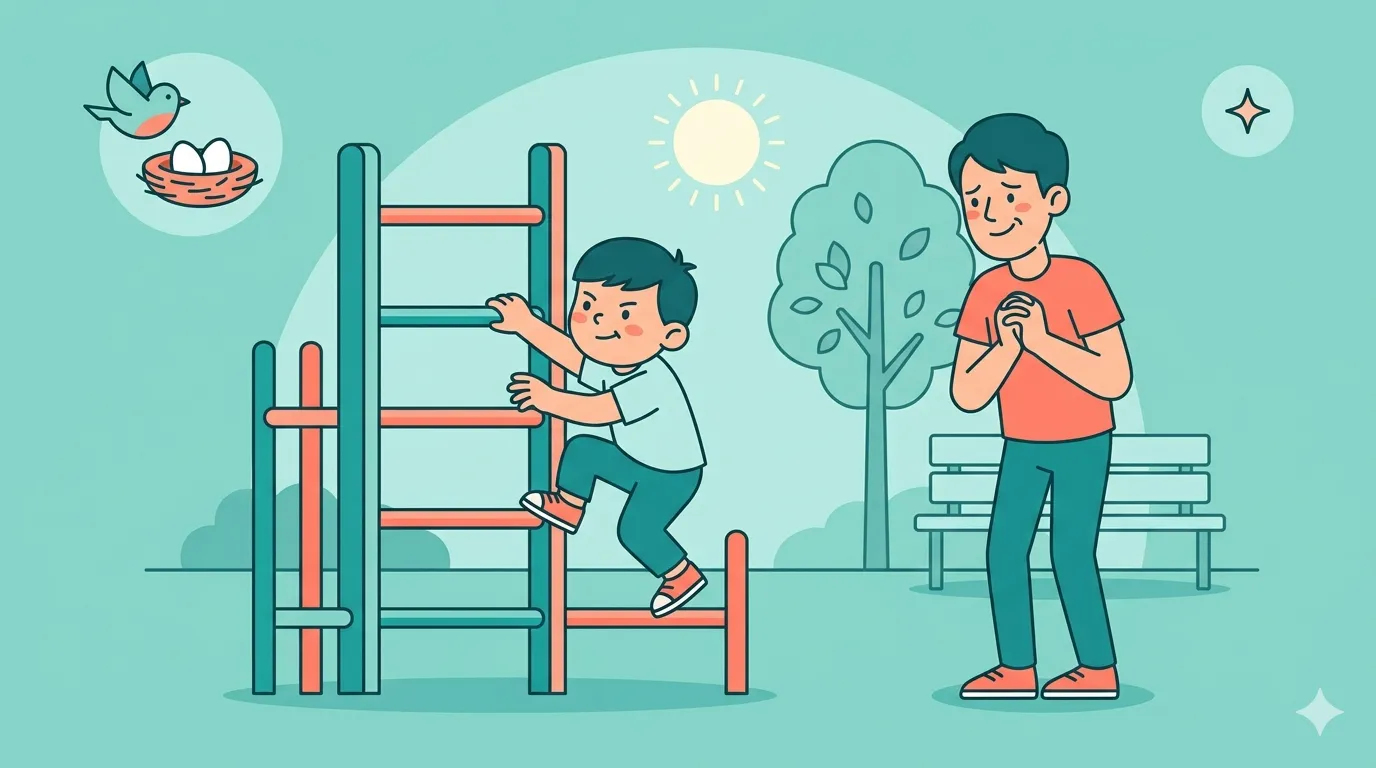
Be careful on that! Hold on tight! Watch your step! Not so high!
I see you climbing. I'm right here if you need me.
Helicopter Parenting Examples: Three Real Scenarios
Scenario 1: The Daycare Drop-Off (Age 3)
Leo is crying at drop-off again. His mother has been extending the goodbye, staying longer, coming back to check — and the crying has been getting worse, not better.
The helicopter approach: Mom stays for 20 minutes, keeps reassuring, texts the teacher every hour, considers pulling him out. Leo learns: my distress controls the situation. My parent can't handle this either.
The confident approach: Mom gives Leo a warm, brief goodbye. "I love you. I'll be back after snack time." She leaves, even though it hurts. She trusts the teachers. Leo cries for four minutes, then joins the block corner. By week three, he waves goodbye. He learns: I can handle hard things. The adults around me believe I can.
Scenario 2: The Playdate Conflict (Age 4)
Sophie and her friend Emma both want the same purple crayon. Voices are rising. Sophie's dad is watching from across the room.
The helicopter approach: Dad walks over immediately. "Sophie, let Emma have the purple. You can use blue. Here, I'll find you another one." Conflict resolved — by the adult.
The confident approach: Dad watches. He waits. Sophie says, "I had it first!" Emma says, "I need it!" Sophie looks at her dad. He gives a small nod — you've got this. Sophie turns back: "You can have it when I'm done." Emma waits. Three minutes later, they trade. Neither child needed rescuing.
Scenario 3: The "I Can't Do It" Moment (Age 5)
Ben is trying to build a bridge with wooden blocks. It keeps collapsing. His face is getting red. He's about to throw a block.
The helicopter approach: Mom swoops in, repositions the blocks, shows him the "right" way. The bridge stands. Ben feels nothing — because he didn't build it.
The confident approach: Mom sits nearby. "That bridge keeps falling. That's really frustrating." She doesn't touch the blocks. Ben tries again. It falls. He tries a different approach — wider base this time. It holds. His face lights up. He built that.
{{info: The moment of frustration right before a child figures something out is the most important moment to not intervene. That struggle is where capability is born.}}
How to Step Back: A Gradual Approach
You don't need to go from helicopter to hands-off overnight. That would be jarring for both you and your child. Instead, think of it as a gradual widening of the circle.
Step 1: Notice Your Triggers
For one week, simply pay attention. When do you feel the pull to intervene? What's the feeling underneath? Write it down if it helps. You might notice patterns: maybe it's physical safety (climbing), maybe it's social situations (playdates), maybe it's academic tasks (puzzles, drawing).
Step 2: Add a Pause
Before you intervene, count to ten. Not because the situation will resolve itself in ten seconds, but because the pause gives you space to choose your response rather than react from anxiety.
Step 3: Ask Instead of Do
Replace "Let me do that for you" with "Do you want help, or do you want to try?" You might be surprised how often the answer is "I want to try."
Step 4: Narrate Without Directing
Instead of telling your child what to do, describe what you see. "You're working on getting your zipper started" is very different from "Here, let me zip that." The first communicates I see you and I trust you. The second communicates you need me to do this.
Step 5: Tolerate the Wobble
This is the hardest part. Your child will struggle. They will get frustrated. They might fail. Your job is to sit with the discomfort of watching — to be the steady pilot who says "We're in some rough air, and I've got this" instead of grabbing the controls.
When Protection Is Appropriate
Stepping back doesn't mean stepping away. There are absolutely situations where your child needs you to intervene:
- Physical safety: A child running toward a street, climbing something genuinely dangerous, near a body of water unsupervised
- Bullying or aggression: When another child is being physically or verbally cruel and your child cannot remove themselves
- Emotional overwhelm beyond their capacity: A toddler in a full meltdown needs co-regulation, not independence
- Situations beyond their developmental stage: Asking a 2-year-old to "work it out" with another toddler is unrealistic
The distinction isn't between intervening and not intervening. It's between necessary intervention and anxiety-driven intervention. One protects your child. The other protects you from discomfort.
Helicopter Parenting vs. Free Range Parenting
Free range parenting is often positioned as the direct opposite of helicopter parenting. Free range parents intentionally give children significant independence — letting them navigate their own conflicts, explore outdoors with minimal supervision, and face natural consequences without adult management.
Both helicopter and free range parents are deeply invested in their children's wellbeing. They've simply reached opposite conclusions about what protection and growth require. Research generally supports giving children more independence than most modern parents default to — not the full hands-off approach of strict free range parenting, but enough space for real struggle and real success.
If helicopter parenting sits at one end of the spectrum, free range parenting sits at the other. Most effective parenting happens closer to the free range end for everyday situations: present enough to offer safety when genuinely needed, but far enough back to let capability develop.
The Connection to Other Parenting Styles
Helicopter parenting often coexists with otherwise warm, loving approaches. Many helicopter parents are authoritative in other aspects — they explain rules, validate feelings, and maintain strong bonds. The over-involvement is typically limited to specific anxiety triggers.
Snowplow parenting — sometimes called lawnmower parenting — takes helicopter tendencies a step further, removing obstacles from a child's path before they encounter them. Where helicopter parents hover ready to intervene, snowplow parents clear the way entirely. Both patterns share the same root: the belief that a child cannot handle difficulty without adult management.
Understanding where helicopter tendencies fit within the broader parenting styles framework can help you see it as a pattern to adjust rather than an identity to feel ashamed about.
I'm a helicopter parent. I'm ruining my child.
I notice I tend to over-intervene in certain situations. I can work on giving my child more space there.
What Your Child Gains When You Step Back
When you resist the urge to hover, you give your child something no amount of protection can provide: the lived experience of their own capability.
- They learn that frustration is temporary and survivable
- They discover that they can solve problems without you
- They build confidence from evidence, not encouragement
- They develop the resilience to handle challenges you can't foresee
- They learn to trust themselves — because you trusted them first
And here's the part nobody talks about: when you step back and watch your child succeed on their own, the pride you feel is different. It's deeper. Because you know they did it — really did it — without you holding the ladder.
Frequently Asked Questions
What is helicopter parenting? Helicopter parenting is a style of over-involved parenting where the parent consistently hovers over their child's activities, decisions, and emotional experiences — intervening before the child has a chance to struggle or solve problems independently. While it comes from love, research shows it can hinder the development of autonomy and resilience.
What are signs of helicopter parenting? Common signs include answering questions directed at your child, intervening at the first sign of conflict, doing tasks your child can handle, feeling intense anxiety when they struggle, and protecting them from all negative emotions. The key indicator is a pattern of preventing manageable difficulty.
What causes helicopter parenting? It's typically driven by parental anxiety — fear of harm, fear of failure, fear of difficult feelings, or patterns from your own childhood. Understanding the root cause is the first step toward change.
What are the effects of helicopter parenting on children? Research links it to increased anxiety, lower self-esteem, difficulty with problem-solving and decision-making, reduced emotional regulation, and struggles with independence. Children who don't practice handling small challenges miss building coping skills for bigger ones.
Is helicopter parenting the same as being a good parent? No. Being attentive and protective is healthy. The difference is whether your involvement helps your child develop skills or prevents them from doing so. A good parent stays close while the child climbs. A helicopter parent holds on so the child never wobbles.
How do I stop being a helicopter parent? Start small. Choose one situation where you normally intervene and pause instead. Let your child struggle for 30 seconds before helping. Ask "Do you want help?" instead of jumping in. Tolerate the discomfort of watching them fumble.
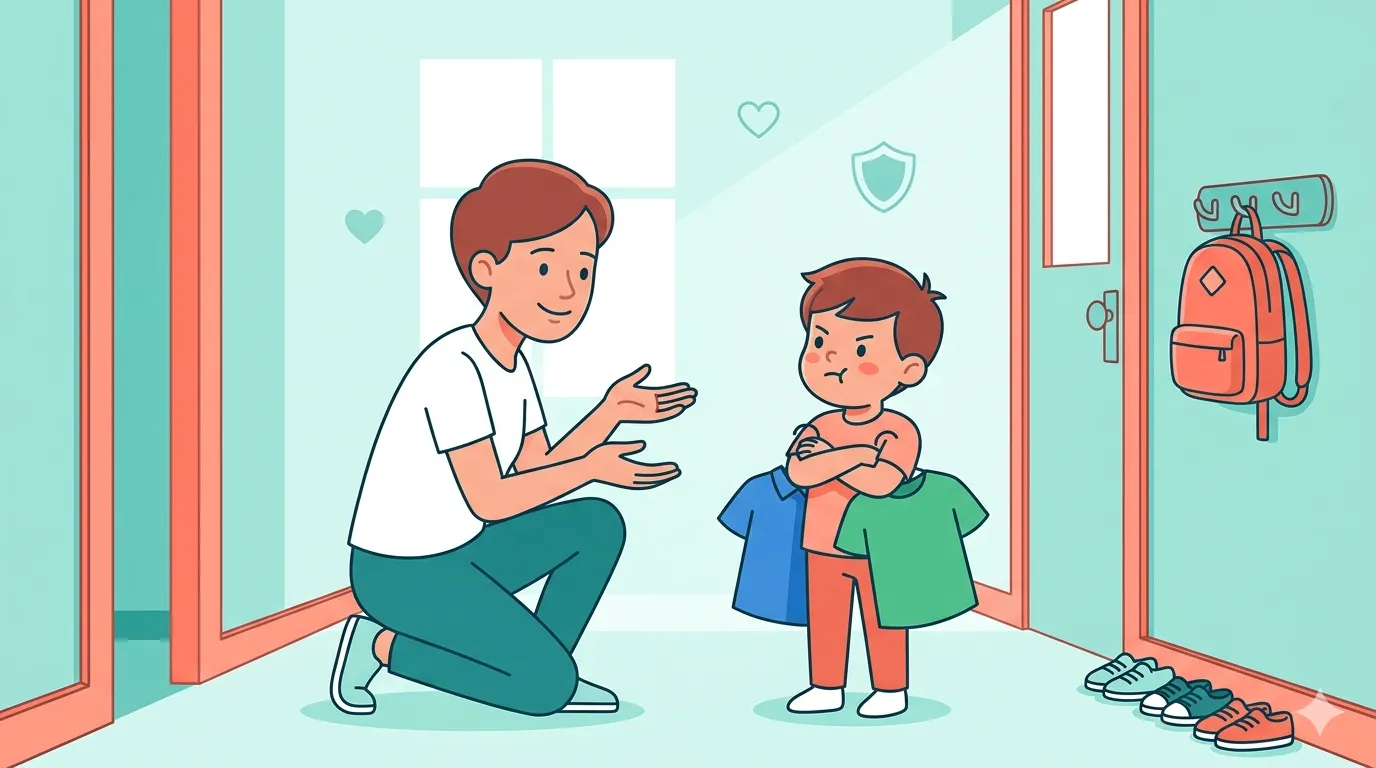
At what age should I give my child more independence? Independence develops gradually. A 2-year-old can choose between two shirts. A 4-year-old can pour cereal. A 6-year-old can resolve a minor disagreement. The question isn't whether they're ready for total independence — it's whether you're offering age-appropriate chances to practice.
Your Next Step
If you see helicopter tendencies in yourself, the most important thing to know is this: the fact that you care this much is your strength, not your weakness. The work isn't learning to care less. It's learning to channel that care differently — from doing for your child to believing in your child.
Start with one moment today. One pause. One "do you want to try?" One deep breath while you watch them wobble.
That wobble is where they grow.
Frequently Asked Questions
Download RootWise Today


Need personalized support?
RootWise's AI coach can provide tailored strategies for your specific situation, available 24/7 when you need it most.
Learn More About AI Coaching →