Phone-Free Childhood for Ages 2-8: What the Anxious Generation Movement Means for Young Kids


Your 4-year-old is not on Instagram. So why does the Anxious Generation matter to you?
Because the skills she'll need to actually thrive without a phone in her hand at age 14 are being built right now - in her capacity for boredom, her comfort outdoors, her ability to make a friend in person, her willingness to do nothing without panicking. None of that gets installed after the phone arrives. It's installed in the years between 2 and 8, mostly through what you don't hand her.
This guide is what the Anxious Generation movement means for parents of young kids - and what to do about it this month, this week, today.
- ✓Jonathan Haidt's four norms (no smartphones before 14, no social media before 16, phone-free schools, unsupervised play) are now driving actual policy in 2026
- ✓~40 US states restrict school phones; Australia banned social media under 16; Manitoba is following; UK Smartphone Free Childhood pact has 85,000+ parents
- ✓The Australian ban reduced default access but 73% of teens stayed on (often with parent help) - bans aren't enough on their own
- ✓For ages 2-8, the work is upstream: build the analog childhood skills now so "wait until 14" is credible later
- ✓Parent phone use in front of kids is a stronger predictor of child screen behavior than the rules parents set
- ✓Phone-free family meals, outdoor default, and joining a local pact are the three highest-leverage moves
Why this conversation got loud in 2026
The headline event was Jonathan Haidt's 2024 book The Anxious Generation, which argued that the shift from a play-based childhood to a phone-based childhood (starting roughly 2010-2012, when smartphone adoption among teens passed 50%) drove the youth mental-health crisis we're now living through. The book proposed four "new norms" - delay smartphones until 14, delay social media until 16, make schools phone-free, and restore unsupervised real-world play.
The shift that matters happened in 2025-2026, when the norms stopped being a book proposal and started becoming policy.
As of May 2026:
- Australia became the first country to ban social media for kids under 16, effective late 2025.
- Manitoba (Canada) is moving on a similar plan - Premier Wab Kinew announced the "first-in-Canada plan to ban social media and AI chatbots for youth" in spring 2026.
- Roughly 40 US states now require school districts to restrict student phone use.
- Denmark, France, and several other European countries have moved on school-day phone bans.
- The UK's grassroots Smartphone Free Childhood pact crossed 85,000 parents across 25 countries.
And the early data is good. A 2024-2025 phone-free schools pilot in Arkansas reported a 51% drop in drug-related offenses and a 57% drop in verbal and physical aggression in its first year.
What this means if your child is 2, 4, 6, or 8
The four norms target older kids. Most of your daily decisions still don't involve a smartphone. But everything you're doing right now is setting the conditions for whether "wait until 14" will be credible in your house.
What "phone-free childhood" looks like at each age
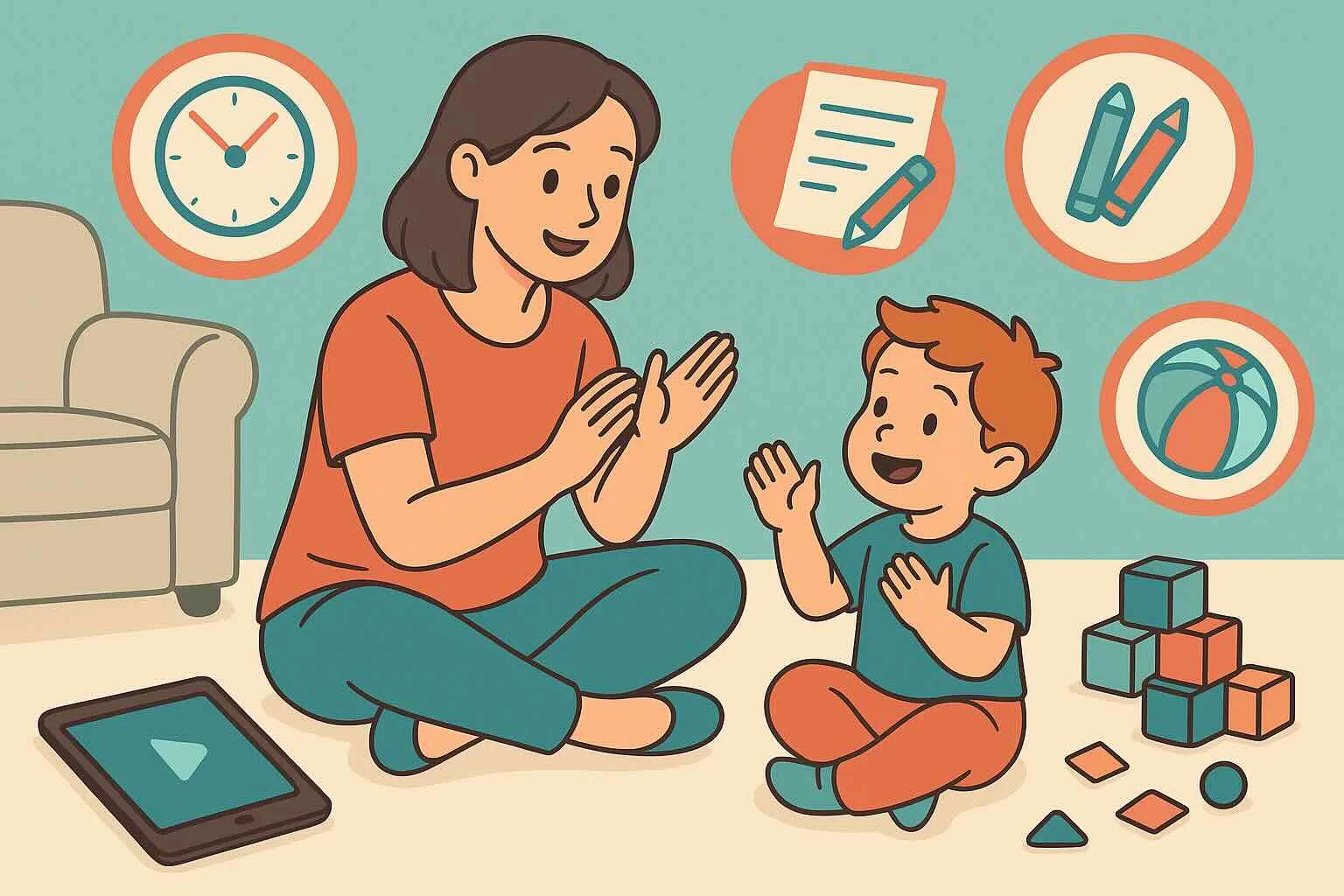
Age 2: No screens except occasional video calls with grandparents. Lots of outdoor time. Lots of safe spaces to be alone (in a yes-corner, in a playpen with toys, on the floor with you nearby but not entertaining). The 18-month AAP guideline is the floor, not the ceiling.
Age 4: Maybe an hour a day of high-quality co-viewed content (you're in the room, you're talking about it, it's not background noise). No tablet of their own. No YouTube without you. Phone-free meals - all meals, all family members. Building a "boredom tolerance" by not filling every empty 10 minutes.
Age 6: Same shape as 4, with the addition of clear conversations about why. Your child is starting to notice that friends have screens. You can name it without shaming anyone: "Different families make different choices. In our family, we wait." Outdoor unstructured play remains the default after-school activity. No personal device.
Age 8: Often the pressure point. Friends are getting smartwatches and kid-phones. School may hand out a Chromebook. This is where the pact-based approach starts to matter (see below). A "dumb phone" for safety, with no internet or apps, is one option some 2026 families are choosing if pickup logistics demand it.
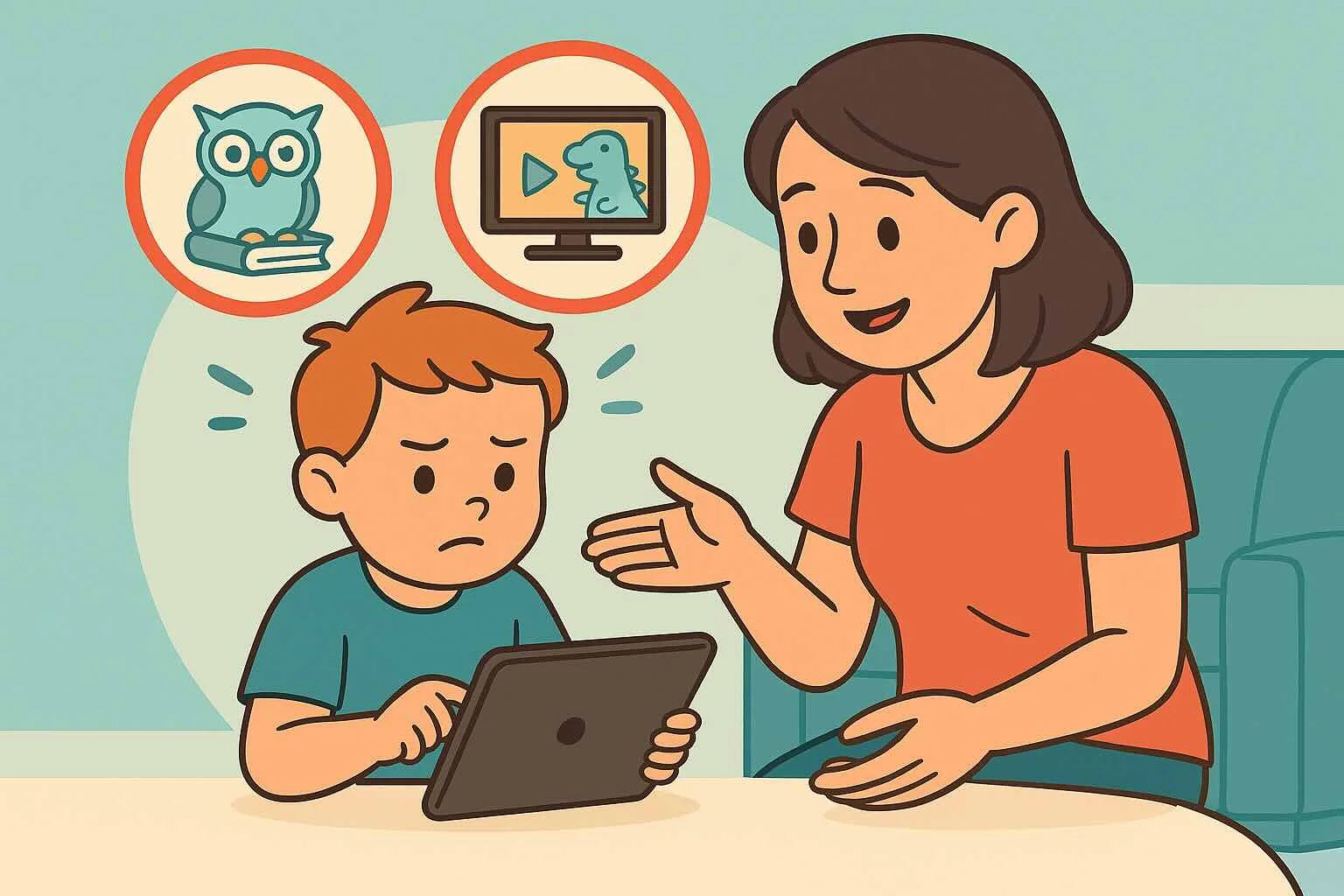
High-stim modern kids' content: jump cuts every 2 seconds, neon colors, manic narrators, songs with no rhythm, no break for thinking.
Lofi calm content: long takes, real animals, real cooking, real building, slower pace, space for your child's brain to keep up and finish a thought.
A widely-shared 2026 Instagram reel celebrated Belgium's 1980s preschool show Tik Tak for being "refreshingly lofi, calming, and always a bit weird." The reel's framing - "it resets my nervous system" - captured something real about why some kids' content destabilizes children and other content settles them.
The uncomfortable part: your phone use in front of your kid
This is the conversation parents don't love, and it's the one 2026 keeps surfacing.
The biggest single predictor of your child's relationship with screens is not the rule you set for them. It's what they watch you do.
If you scroll through every meal, take a phone call at the playground, check email during bath time, or have your phone face-up on the coffee table during the bedtime story - your child is learning that's what adults do. Their nervous system is wiring the expectation: "the phone is always more important than the moment."
One of the most-shared X posts of May 2026 said it bluntly: "If TVs are always on and parents are always on a phone, then kids will want to be on a screen. Fill their environment with positive and healthy things."
The one-week test: leave your phone in another room during all meals and during the entire bedtime routine. Just for a week. Most parents find:
- It's harder than they thought.
- It changes the quality of the time more than they expected.
- Their kid notices.
This isn't a guilt trip. This is the single most leveraged screen-time intervention you can make, and it doesn't require any rules for your child at all.
The four norms, translated for the 2-8 parent
Norm 1: No smartphones before 14
Your work between ages 2 and 8: build the analog skills that make "wait until 14" credible. That means boredom tolerance, outdoor default, the ability to make a friend in person, deep focus on a non-digital task, the experience of being unsupervised in safe ways. See our boredom and free play guide for the practical mechanics.
Norm 2: No social media before 16
For young kids: no posting their meltdowns, potty fails, or daily routines on your own social media. The "sharenting" pullback is partly about consent - the first generation of social-media kids has reached adulthood and many are unhappy. A simple test: would your 18-year-old be okay with this post existing?
Norm 3: Phone-free schools
Your kid's preschool probably doesn't have phones. But many elementary schools are heading toward 1:1 Chromebooks starting in 1st or 2nd grade. This is a fight worth having. Show up at school board meetings, ask about screen-free alternatives, and talk to other parents. Real change happens when 10 families ask the same question.
Norm 4: Restore unsupervised real-world play
Independence and life skills are being rebuilt as core 2026 trends. Let your 4-year-old play in the backyard alone. Let your 6-year-old walk to a neighbor's house. Let your 8-year-old run an errand to the corner store. The "free-range" stigma of the 2010s is fading, and many states have passed "reasonable childhood independence" laws making it legally clearer. See our teaching independence guide for age-by-age.
Joining (or starting) a phone-free pact
The reason individual parent decisions break is the "everyone else has one" pressure. The reason pacts work is they eliminate exactly that.
The UK's Smartphone Free Childhood movement is the largest example - 85,000+ parents across 25 countries had signed by early 2026, agreeing to wait until at least year 9 (age 14) for a smartphone. The model is being copied in the US, Canada, Australia, and across Europe.
You don't need to wait for someone else to start one.
The five-text recipe:
- Identify 5 families from your child's preschool or kindergarten class whose kids you actually like.
- Send the same short text to all of them: "We're thinking about waiting on smartphones until [age/grade]. Would you be interested in committing together as a group?"
- If two or three say yes, you have a pact. Pick a Saturday-morning coffee to meet in person.
- Define together: what age, what counts (smartwatch? dumb phone? family iPad?), and what you'll do when one family caves.
- Write it down. Share it. Repeat the conversation every year.
The presence of even 3-4 families committed publicly changes the social texture in a class. Your child grows up knowing "we wait" is normal, not weird.
What to do this month
If you only do three things, do these:
- Phone-free family meals. Adults included. All meals. Phones in another room, not face-down on the table. Hold the line for two weeks.
- One outdoor default block. Pick a daily 30-60 minute window where outside is the default, even in mediocre weather. Build the muscle now.
- One conversation with another family. Just one. Plant the seed of a pact. You don't need to formalize anything in the first conversation.
What to read next
- The complete screen time guide - age-by-age tactical detail
- Screen time rules and boundaries - the practical "how"
- Screen time alternatives and activities - what to actually do instead
- Boredom and free play - the developmental case for letting them be bored
- Teaching independence and life skills - the other half of the analog childhood
- 2026 parenting trends round-up - the full picture
The one-line summary
The Anxious Generation movement isn't about your 4-year-old's phone (she doesn't have one). It's about the analog skills she needs to thrive without one later. Build those between 2 and 8 - boredom tolerance, outdoor play, real friends, deep focus - and the harder conversations at 11, 13, 15 will be conversations you can actually win. Start with a phone-free dinner this week.
Frequently Asked Questions
Download RootWise Today


Need personalized support?
RootWise's AI coach can provide tailored strategies for your specific situation, available 24/7 when you need it most.
Learn More About AI Coaching →